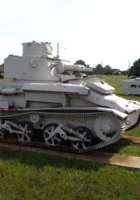
Tanque leve Mk VI

Light Tank Mk VI

PaísReino unido
PapelTanque de luz
Em serviço1936–1942
Construído1682

O tanque, Light, Mk VI was a British light tank, produced by Vickers-Armstrongs in the late 1930s, which saw service during the Second World War. The Tank, Light, Mk VI was the sixth in the line of light tanks built by Vickers-Armstrongs for the British Army during the interwar period. The company had achieved a degree of standardization with their previous five models, and the Mark VI was identical in all but a few respects.

Fonte: Tanque Leve Mk VI na Wikipedia

Continue lendo

Visualizações : 2154

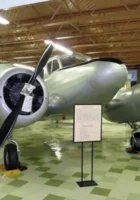
Cessna AT-17 Bobcat

Cessna AT-17 Bobcat

PaísEua
PapelTransporte leve de cinco lugares
concebido26 de março de 1939
Construído5422

O Cessna AT-17 Bobcat foi um avião bimotor de treinamento avançado projetado e fabricado nos Estados Unidos, e usado durante a Segunda Guerra Mundial para preencher a lacuna entre treinadores monomotores e aviões de combate bimotores. O AT-17 era alimentado por dois motores radiais Jacobs R-755-9. A versão comercial foi o modelo T-50, a partir do qual o AT-17 foi desenvolvido.

Fonte: Cessna AT-17 Bobcat na Wikipédia

Continue lendo

Views : 1818

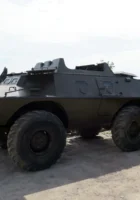
V-100 Comando

Cadillac Gage Commando

PaísEua
PapelCarro blindado
concebidojunho de 1962
Construído3200+

O Cadillac Gage Commando, frequentemente denotado como o M706 no serviço militar dos EUA, era um carro blindado americano projetado para ser anfíbio. Foi projetado por Cadillac Gage especificamente para o Corpo de Polícia Militar dos Estados Unidos durante a Guerra do Vietnã como um veículo armado de escolta de comboios. O Commando foi um dos primeiros veículos a combinar os papéis tradicionalmente separados de um porta-aviões blindado e um carro blindado convencional, assim como o SOVIÉTICO BTR-40. Sua notável altura, capacidade anfíbia e motor impermeável permitiram que as equipes americanas lutassem efetivamente nas selvas do Vietnã observando seus oponentes sobre vegetação espessa e fording os rios profundos do país

Fonte: Cadillac Gage Commando na Wikipédia

Continue lendo

Visualizações : 2362

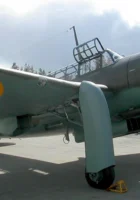
SAAB B17

SAAB B17

PaísSuécia
PapelBombardeiro de reconhecimento
Primeiro voo18 de maio de 1940
Construído323

O Saab 17 was a Swedish bomber-reconnaissance aircraft. The project was initiated in response to a request in 1938 from the Swedish air force for a reconnaissance aircraft that could replace the Fokker S 6. Design work began at the end of the 1930s as the L 10 by ASJA, but after the merger with Saab in 1939 it was renamed Saab 17. The wings were reinforced to make it possible for use as a dive bomber. Since there was a shortage of engines the aircraft were flown to their destination, where the engines were removed and returned for use by the next delivery. The aircraft was also made in three versions with different engines.

Fonte: SAAB B17 na Wikipédia

Continue lendo

Visualizações : 2715

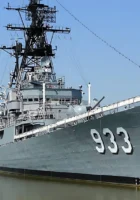
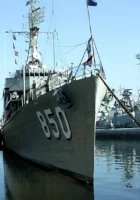
Destroier USS Barry

USS Barry (DD-933)

PaísEua
Classe – TipoForrest Sherman – destroier de classe
Lançado1 de Outubro de 1955
Descomissionado5 de Novembro de 1982

USS Barry (DD-933) was one of eighteen Forrest Sherman–class destroyers of the United States Navy, and was the third US destroyer to be named for Commodore John Barry. Commissioned in 1954, she spent most of her career in the Caribbean, Atlantic, and Mediterranean, but also served in the Vietnam War, for which she earned two battle stars. Another notable aspect of her service was the Cuban Missile Crisis in 1962. Decommissioned in 1982, she became the “Display Ship Barry” (DS Barry), a museum ship at the Washington Navy Yard in Washington, D.C., in 1984.

Fonte: USS Barry (DD-933) na Wikipédia

Continue lendo

Visualizações : 1816

USS Salem

USS Salem (CA-139)

PaísEua
Classe – TipoDes Moines-class – Heavy cruiser
Lançado25 March 1947
Descomissionado30 January 1959

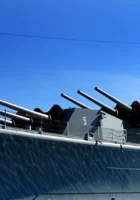
The third USS Salem (CA-139) is one of three Des Moines-class heavy cruisers completed for the United States Navy shortly after World War II. Commissioned in 1949, she was the world’s last heavy cruiser to enter service and the only one still in existence. She was decommissioned in 1959, after serving in the Atlantic and Mediterranean. She is open to the public as a museum ship in Quincy, Massachusetts

Fonte: USS Salem (CA-139) on Wikipedia

Continue lendo

Visualizações : 2609

Submarino anão alemão Seehund

Seehund

PaísGermnay
PapelSubmarino Midget
Produzido1944–1945
Construído285

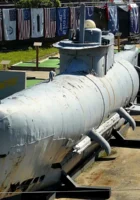
O Seehund (em alemão: "foca"), também conhecido como Tipo XXVII, foi um submarino anão fabricado pela Alemanha nazista durante a Segunda Guerra Mundial. Projetado em 1944 e operado por tripulações de dois homens, foi usado pela Kriegsmarine (Marinha Alemã) durante os meses finais da guerra, afundando nove navios mercantes e danificando outros três, enquanto perdia 35 barcos, principalmente atribuídos ao mau tempo. A Marinha francesa usou três barcos capturados após a guerra até 1953.

Fonte: Seehund na Wikipédia

Continue lendo

Visualizações : 2261

Krupp Protze Kfz

TKrupp Kfz.81 Protze

PaísGermnay
PapelTrator de artilharia / caminhão utilitário
Produzido1934–1941
Construído7000

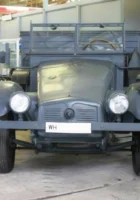
O L 2 H 43 e L 2 H 143 "Krupp-Protze” (unofficial designation) was a six-wheeled 6×4 German truck and artillery tractor produced between 1934 and 1941 and heavily used in World War II. It was powered by a 4-cylinder, 55 hp or, from 1936, 60 hp Krupp M 304 petrol engine. Its main purpose was to tow artillery, especially the PaK 36, and transport motorized infantry. This vehicle was extensively used on the Eastern Front, during the North African campaign and in France and Sicily. The “Krupp-Protze” was of relatively advanced design. Its fuel consumption was relatively high (24 Litres / 100 km on road) in comparison to the comparable Opel Blitz 1.5 t truck (16.5 liters / 100 km, produced 1938 – 1942). Total production was about 7,000 units.

Fonte: Krupp Automobile.81 Protze na Wikipédia

Continue lendo

Views : 4532

Submarino anão tipo A

Type A Midget Submarine

PaísImpério do Japão
classeSubmarino da classe Kō-hyōteki
PeríodoSegunda Guerra Mundial
ConstruídoDesconhecido

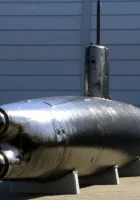
O Tipo A Ko-hyoteki (甲標的甲型 Kō-hyōteki kō-gata, Target ‘A’, Type ‘A’) class was a class of Japanese midget submarines (Ko-hyoteki) used during World War II. They had hull numbers but no names. For simplicity, they are most often referred to by the hull number of the mother submarine. Thus, the midget carried by I-16-class submarine was known as I-16’s boat, or “I-16tou.” This class was followed by: Type B (甲標的乙型 Kō-hyōteki otsu-gata), Type C (甲標的丙型 Kō-hyōteki hei-gata), and Type D (甲標的丁型 Kō-hyōteki tei-gata), the last one better known as Kōryū

Fonte: Tipo Um Submarino Midget na Wikipedia

Continue lendo

Visualizações : 2054

USS Joseph Kennedy

USS Joseph P. Kennedy

PaísEua
classeDestroier classe engrenagem
Lançado26 de julho de 1945
ApelidoJoey P

USS Joseph P. Kennedy Jr. (DD-850) é um ex-destróier da classe Gearing da Marinha dos Estados Unidos. O navio recebeu o nome do tenente Joseph P. Kennedy Jr., um aviador naval, filho do ex-embaixador na Grã-Bretanha, Joseph P. Kennedy Sr., e irmão mais velho do futuro presidente John F. Kennedy. Joseph P. Kennedy Jr. serviu, com interrupções para modernização, até 1973. Entre os destaques de seu serviço estão o bloqueio de Cuba durante a Crise dos Mísseis de Cuba e as equipes de recuperação à tona para Gemini 6 e Gemini 7. Joseph P. Kennedy Jr. está em exibição como um navio-museu em Battleship Cove, Fall River, Massachusetts. Ele foi adicionado ao Registro Nacional de Lugares Históricos em 1976, e designado um Marco Histórico Nacional em 1989 como um de um pequeno número de destroieres sobreviventes da classe Gearing.

Fonte: USS Joseph P. Kennedy na Wikipédia

Continue lendo

Visualizações : 1023