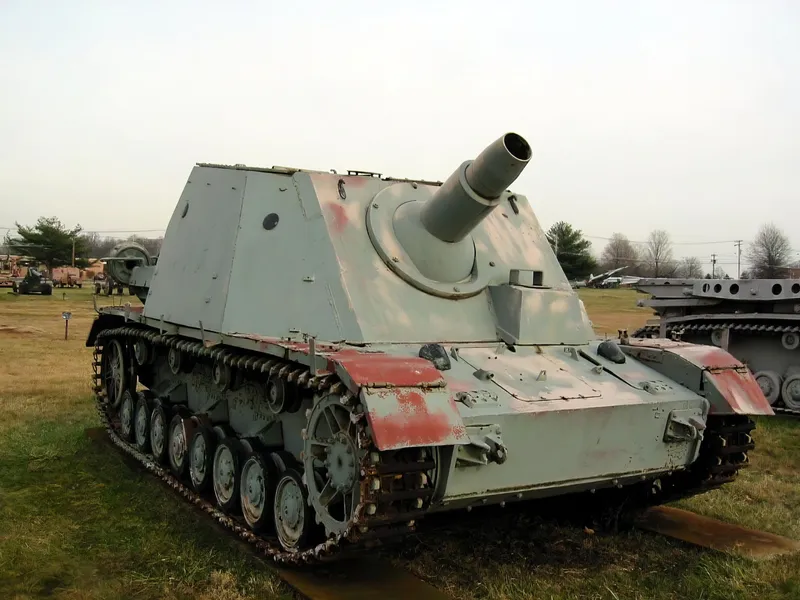
Brummbär – Sturmpanzer IV – Sd.Kfz 166 | |
|---|---|
| Pays | Germany |
| Type | Heavy assault gun |
| Produced | 1943–1945 |
| Built | 306 |
The Sturmpanzer (also known as Sturmpanzer 43 or Sd.Kfz. 166) was a German armoured infantry support gun based on the Panzer IV chassis used in the Second World War. It was used at the Battles of Kursk, Anzio, Normandy, and was deployed in the Warsaw Uprising. It was known by the nickname Brummbär (German: “Grouch”) by Allied intelligence, a name which was not used by the Germans. German soldiers nicknamed it the “Stupa”, a contraction of the term Sturmpanzer. Just over 300 vehicles were built and they were assigned to four independent battalions.
Source: Brummbar on Wikipedia
| Brummbar – Sturmpanzer IV – Sd.Kfz.166 – Walk Around | |
|---|---|
| Photographer | Unknow |
| Localisation | Unknow |
| Photos | 70 |
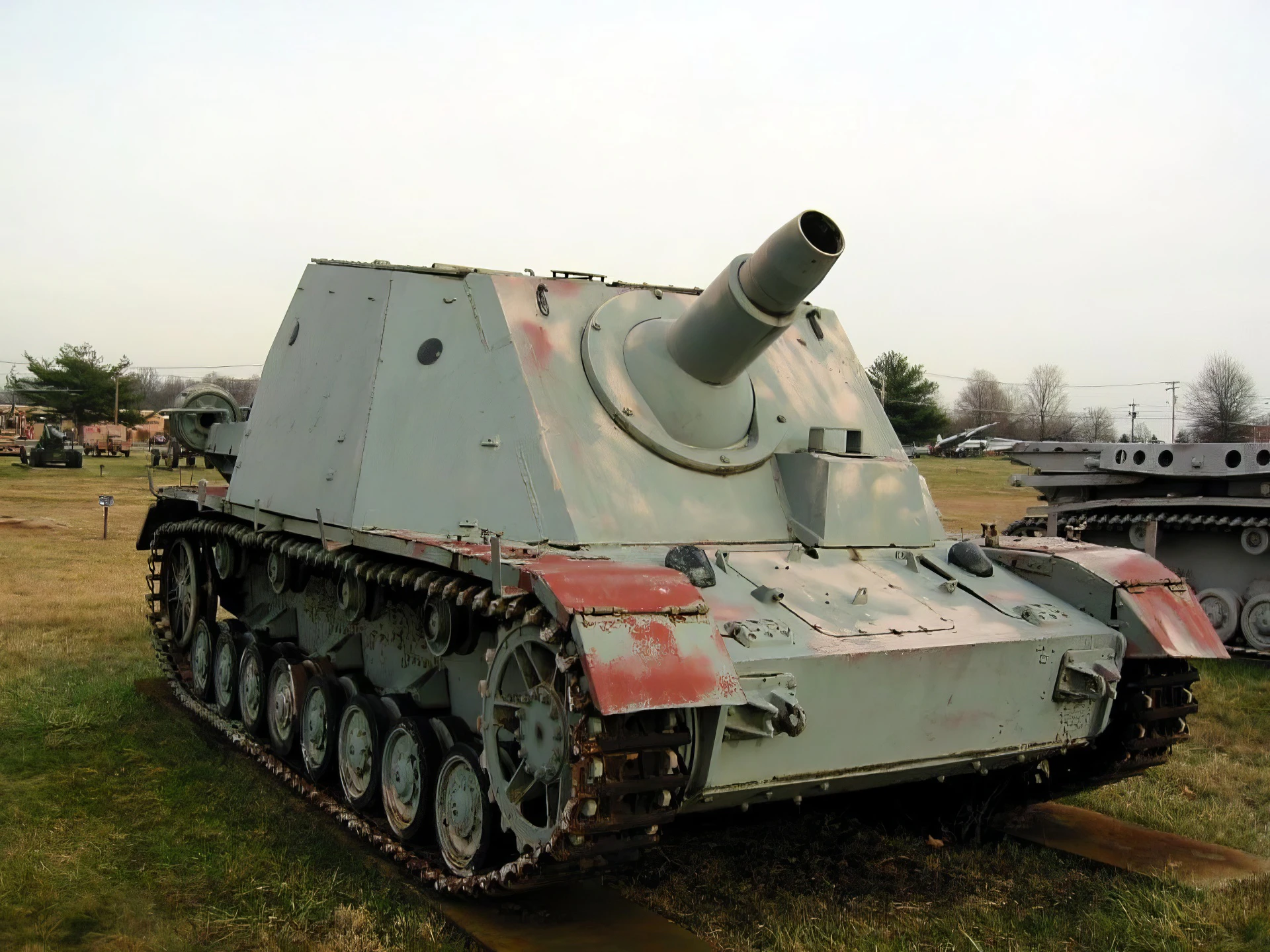


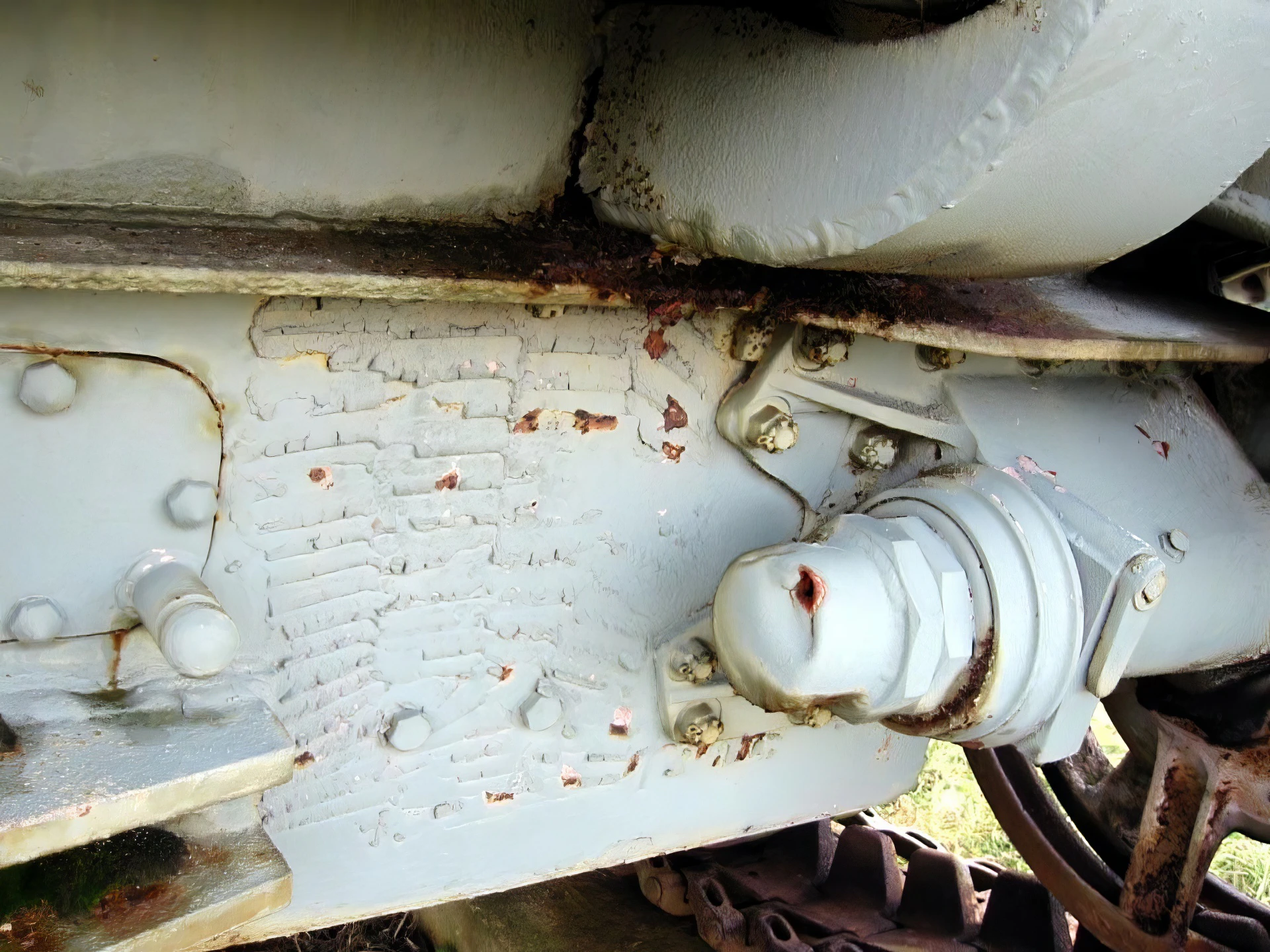


| Sdkfz 166 Brumbar Walk Around | |
|---|---|
| Photographers | Matthew Flegal, Vladimir Yakubov |
| Localisation | Unknow |
| Photos | 99 |
See also:


The Sturmpanzer 43 (Assault Tank) with the official designation Sd.Kfz. 166 was a German armored infantry support gun (or assault howitzer) of World War II. It is widely known by the nickname “Brummbär” (German for “Grumbler” or “Grouch”), a name reportedly given to it by Allied intelligence, not German troops.
Its primary role was heavily armored, direct-fire support for infantry in urban combat and against hardened fortifications, utilizing a massive, short-barreled howitzer.
Key Features and Specifications
- Chassis: Built upon the reliable Panzerkampfwagen IV (Panzer IV) medium tank chassis.
- Main Armament: The 15 cm Sturmhaubitze 43 L/12 (StuH 43). This massive 150 mm howitzer was designed to fire heavy High-Explosive (HE) shells to demolish buildings and bunkers. It had limited traverse in its fixed superstructure, classifying it as an assault gun rather than a tank.
- Armor: The vehicle featured thick frontal armor on its casemate superstructure, reaching up to 100 mm (though sources vary, sometimes listing up to 150mm on later versions). This made it highly resistant to most Allied anti-tank guns at the time of its introduction.
- Crew: 5 (Commander, Gunner, Loader, Driver, Radio Operator/Bow Machine Gunner).
- Weight & Mobility: The addition of the large gun and heavy armor made the vehicle significantly heavier than the standard Panzer IV, resulting in mechanical strain, particularly on the chassis and transmission. Its high profile also made it a conspicuous target.
- Secondary Armament: Early versions lacked a bow machine gun, making them vulnerable to infantry at close range. Later production models incorporated a ball-mounted MG 34 machine gun in the front plate for close defense.
Combat History and Effectiveness
The Sturmpanzer was formed into dedicated assault tank battalions (e.g., Sturmpanzer-Abteilung 216).
Operational Highlights
- First Action: It first saw combat on the Eastern Front, notably during the Battle of Kursk (Summer 1943), where its heavy howitzer was employed against Soviet defensive positions.
- Siege Weapon: Its heavy HE shells were extremely effective against concrete positions, field fortifications, and in urban warfare, such as during the fighting at Anzio (Italy) and the brutal suppression of the Warsaw Uprising (Poland) in 1944.
- Limitation: Due to its short-barreled, low-velocity gun primarily firing HE rounds, the Sturmpanzer was generally unsuitable for direct combat against enemy tanks, though it could use shaped-charge rounds (Hohlladung) if necessary.
- Logistics and Reliability: Like many over-engineered German vehicles, the Sturmpanzer suffered from limited operational range and mechanical reliability issues due to the overweight design, leading to many being abandoned due to breakdowns rather than combat damage.
Views : 8170