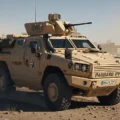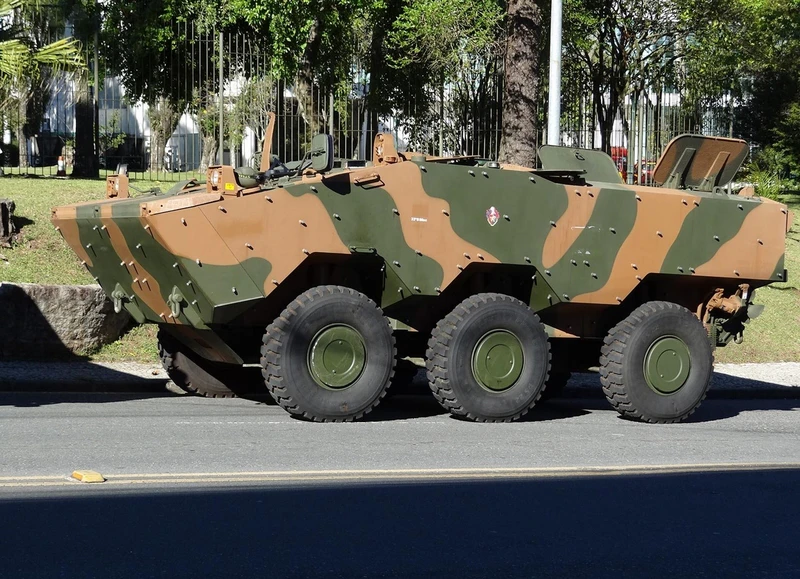
VBTP-MR Guarani | |
|---|---|
| Pays | Brésil |
| Rôle | Véhicule blindé de transport de troupes |
| Fabricant | Iveco |
| Construit | Inconnu |
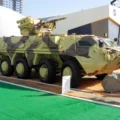
Lla VBTP-MR Guarani est un véhicule blindé de transport de troupes de 6×6 développé par Iveco et l’armée brésilienne dans le cadre de son « URUTU-III » programme de modernisation visant à remplacer tous les EE-11 Urutu d’ici 2015. La version 8×8 du VBTP-MR est la base d’Iveco’s Véhicule blindé de transport de troupes Superav. Dans le programme d’autres entreprises brésiliennes ont également participé, tels que IMBEL (Communications), ELBIT (Armements), Usiminas et Villares (développement de l’acier structurel balistique national).
Source: VBTP-MR Guarani sur Wikipedia
| IVECO – VBTP-MR Guarani Walk Around | |
|---|---|
| Photographer | Gino Marcomini |
| Localisation | Unknow |
| Photos | 41 |


Voir aussi :


General Characteristics
The Panther Ausführung G (Ausf G) was the final and most numerous production model of the German Panther medium tank. It was introduced in 1944 and served until the end of World War II. It featured several design simplifications and improvements over previous models, including increased side hull armor and a redesigned gun mantlet (the ‘chin’ mantlet) intended to eliminate the ‘shot trap’ that could deflect rounds down onto the thin hull roof. Though classified as a medium tank, its 45.5 tonne weight placed it closer to contemporary heavy tanks. It is often cited as one of the best tanks of the war for its combination of firepower, mobility, and sloped frontal protection. (Note: The provided image library does not contain a Panther tank image; a generic image is used for illustration.)
| Property | Typical Value (Ausf G) |
|---|---|
| Rôle | Medium Tank (Heavy Tank classification by weight) |
| National Origin | Allemagne nazie |
| Fabricants | MAN, Daimler-Benz, MNH |
| Production Period | March 1944 – April 1945 |
| No. Built | Approx. 3,126 (Most numerous Panther variant) |
| Crew | 5 (Commander, Gunner, Loader, Driver, Radio Operator) |
| Mass (Combat) | 45.5 tonnes (45,500 kg) |
| Length (Gun forward) | 8.66 m (28 ft 5 in) |
| Width | 3.27 m (10 ft 9 in) |
| Height | 2.85 m (9 ft 4 in) |
Armor and Mobility
- Armor (Hull Glacis Front): 80 mm at 55° slope (provides high effective thickness).
- Armor (Hull Lower Front): 60 mm at 55° slope.
- Armor (Hull Side): Increased to 50 mm (from 40 mm on previous models) at a steep angle.
- Armor (Turret Front): 110 mm at 11° slope.
- Armor (Gun Mantlet): 100 mm (round/wedge-shaped « chin » mantlet).
- Engine: Maybach HL 230 P30 V12 water-cooled petrol engine.
- Power Output: 515 kW (700 PS / 690 hp) at 3,000 rpm.
- Maximum Speed (Road): Approx. 46 km/h (29 mph).
- Operational Range (Road): Approx. 200–250 km (124–155 mi).
- Suspension: Dual torsion bar with interleaved road wheels.
Armement
- Main Armament: One 7.5 cm KwK 42 L/70 tank gun.
- Ammunition Carried: 79–82 rounds.
- Penetration Capability: High velocity and long barrel gave it exceptional anti-tank capability, capable of penetrating most Allied armor at long ranges.
- Secondary Armament:
- One 7.92 mm MG 34 machine gun (coaxial with main gun).
- One 7.92 mm MG 34 machine gun (hull-mounted in a ball mount).
- Note: Later production batches of the Ausf G introduced the redesigned mantlet to mitigate a vulnerability known as the « shot trap. »
Views : 1163