SAAB B17

SAAB B17

PaysSuède
RôleBombardier, reconnaissance
Premier volLe 18 mai 1940
Construit323

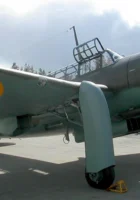
Lla Saab 17 was a Swedish bomber-reconnaissance aircraft. The project was initiated in response to a request in 1938 from the Swedish air force for a reconnaissance aircraft that could replace the Fokker S 6. Design work began at the end of the 1930s as the L 10 by ASJA, but after the merger with Saab in 1939 it was renamed Saab 17. The wings were reinforced to make it possible for use as a dive bomber. Since there was a shortage of engines the aircraft were flown to their destination, where the engines were removed and returned for use by the next delivery. The aircraft was also made in three versions with different engines.

Source: SAAB B17 sur Wikipedia

Lire l’article

Vues : 2710

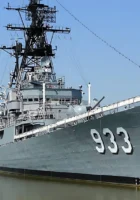
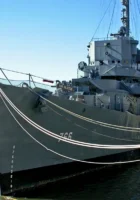
USS Barry Destroyer

USS Barry (DD-933)

PaysUsa
Classe – TypeForrest Sherman – destroyer de classe
Lancé1er octobre 1955
Déclassés5 novembre 1982

USS Barry (DD-933) was one of eighteen Forrest Sherman–class destroyers of the United States Navy, and was the third US destroyer to be named for Commodore John Barry. Commissioned in 1954, she spent most of her career in the Caribbean, Atlantic, and Mediterranean, but also served in the Vietnam War, for which she earned two battle stars. Another notable aspect of her service was the Cuban Missile Crisis in 1962. Decommissioned in 1982, she became the « Navire d’exposition Barry » (DS Barry), un navire-musée au Washington Navy Yard à Washington, D.C., en 1984.

Source: USS Barry (DD-933) sur Wikipedia

Lire l’article

Vues : 1810

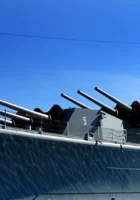
USS Salem

USS Salem (CA-139)

PaysUsa
Classe – TypeClasse Des Moines – Croiseur lourd
Lancé25 mars 1947
Déclassés30 janvier 1959

Le troisième USS Salem (CA-139) est l’un des trois croiseurs lourds de classe Des Moines achevés pour l’United States Navy peu après la Seconde Guerre mondiale. Mis en service en 1949, il était le monde’dernier croiseur lourd à entrer en service et le seul encore en existence. Il a été désarmé en 1959, après avoir servi dans l’Atlantique et la Méditerranée. Il est ouvert au public en tant que navire musée à Quincy, Massachusetts

Source: USS Salem (CA-139) sur Wikipédia

Lire l’article

Vues : 2606

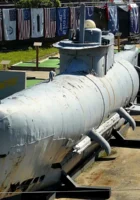
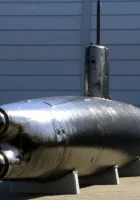
Sous-marin nain allemand seehund

Seehund

PaysGermnay ( Germnay )
RôleSous-marin midget
Produit1944–1945
Construit285

Lla Seehund (Allemand: « Phoque »), également connu sous le nom de Type XXVII, était un sous-marin de poche fabriqué par l’Allemagne nazie pendant la Seconde Guerre mondiale. Conçu en 1944 et exploité par des équipages de deux hommes, il a été utilisé par la Kriegsmarine (marine allemande) pendant les derniers mois de la guerre, coulant neuf navires marchands et en endommageant trois autres, tout en perdant 35 bateaux, principalement attribués au mauvais temps. La marine Français a utilisé trois bateaux capturés après la guerre jusqu’en 1953.

Source: Seehund sur Wikipedia

Lire l’article

Vues : 2254

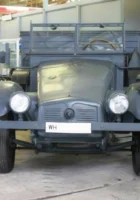
Krupp Protze Kfz

TKrupp Kfz.81 Protze

PaysGermnay ( Germnay )
RôleTracteur d’artillerie / Camion utilitaire
Produit1934–1941
Construit7000

Le L 2 H 43 et le L 2 H 143 « Krupp-Protze » (unofficial designation) was a six-wheeled 6×4 German truck and artillery tractor produced between 1934 and 1941 and heavily used in World War II. It was powered by a 4-cylinder, 55 hp or, from 1936, 60 hp Krupp M 304 petrol engine. Its main purpose was to tow artillery, especially the PaK 36, and transport motorized infantry. This vehicle was extensively used on the Eastern Front, during the North African campaign and in France and Sicily. The « Krupp-Protze » était de conception relativement avancée. Sa consommation de carburant était relativement élevée (24 litres / 100 km sur route) par rapport au camion Opel Blitz de 1,5 t comparable (16,5 litres / 100 km, produit de 1938 à 1942). La production totale était d’environ 7 000 unités.

Source: Krupp Kfz.81 Protze sur Wikipedia

Lire l’article

Vues : 4524

Sous-marin midget de type A

Type A Midget Submarine

PaysEmpire du Japon
ClasseSous-marin de classe Kō-hyōteki
PériodeSeconde Guerre mondiale
ConstruitInconnu

Lla Type A Ko-hyoteki (甲標的甲型 Kō-hyōteki kō-gata, Cible ‘Un’Type ‘Un’) était une classe de sous-marins nains japonais (Ko-hyoteki) utilisés pendant la Seconde Guerre mondiale. Ils avaient des numéros de coque, mais pas de noms. Par souci de simplicité, ils sont le plus souvent mentionnés par le numéro de coque du sous-marin mère. Ainsi, le nain transporté par sous-marin de classe I-16 était connu sous le nom d’I-16’s bateau, ou « I-16tou. » Cette classe a été suivie par : type B (甲標的乙型 Kō-hyōteki otsu-gata), type C (甲標的丙型 Kō-hyōteki hei-gata), et type D (甲標的丁型 Kō-hyōteki tei-gata), le dernier mieux connu sous le nom de Kōryū

Source: Type A Midget Submarine sur Wikipedia

Lire l’article

Vues : 2049

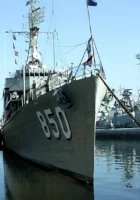
L’USS Joseph Kennedy

USS Joseph P. Kennedy

PaysUsa
ClasseDestroyer de classe Engrenage
Lancé26 juillet 1945
SurnomJoey P

USS Joseph P. Kennedy Jr. (DD-850) est un ancien destroyer de classe Gearing de l ' United States Navy. Le navire a été nommé d’après le lieutenant Joseph P. Kennedy Jr., un aviateur naval, fils de l’ancien ambassadeur en Grande-Bretagne, Joseph P. Kennedy Sr., et frère aîné du futur président John F. Kennedy. Joseph P. Kennedy Jr. a servi, avec des interruptions pour la modernisation, jusqu’en 1973. Parmi les faits saillants de son service figurent le blocus de Cuba pendant la crise des missiles de Cuba et les équipes de récupération à flot pour Gemini 6 et Gemini 7. Joseph P. Kennedy Jr. est exposé comme un navire-musée à Battleship Cove, Fall River, Massachusetts. Il a été ajouté au registre national des lieux historiques en 1976 et désigné monument historique national en 1989 comme l’un des rares destroyers survivants de la classe Gearing.

Source: USS Joseph P. Kennedy sur Wikipédia

Lire l’article

Vues : 1023

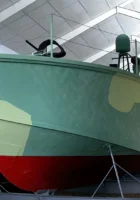
PT Bateau PT-617

PT boat

PaysUsa
ClasseEscorte de destroyers de classe Cannon
Lancé20 février 1944
identificationDE-766

Un Pt boat (abréviation de patrol torpedo boat) était un navire d’attaque rapide armé de torpilles (MTB) utilisé par l’United States Navy pendant la Seconde Guerre mondiale. Il était petit, rapide et peu coûteux à construire, apprécié pour sa maniabilité et sa vitesse, mais entravé au début de la guerre par des torpilles inefficaces, un armement limité et une construction relativement fragile qui limitait certaines des variantes aux eaux côtières.

Source: PT boat sur Wikipédia

Lire l’article

Vues : 2410

L’USS Slater

USS Slater

PaysUsa
ClasseEscorte de destroyers de classe Cannon
Lancé20 février 1944
identificationDE-766

L’USS Slater (DE-766) is a Cannon-class destroyer escort that served in the United States Navy and later in the Hellenic (Greek) Navy. The ship was named for Frank O. Slater of Alabama, a sailor killed on the cruiser USS San Francisco during the Naval Battle of Guadalcanal. He was posthumously awarded the Navy Cross for gallantry in action and the Purple Heart. Following service during World War II, the ship was transferred to Greece and renamed Aetos. Decommissioned in 1991, the destroyer escort was returned to the United States. USS Slater is now a museum ship on the Hudson River in Albany, New York, the only one of its kind afloat in the United States. (USS Stewart (DE-238) is exhibited at Seawolf Park in Galveston, Texas, but located on dry land and USS Atherton (DE-169) is still in service in the Philippine Navy.) Slater was designated a National Historic Landmark on 2 March 2012

Source: USS Slater sur Wikipédia

Lire l’article

Vues : 1103

Véhicule de reconnaissance Lynx

Lynx reconnaissance vehicle

PaysUsa
RôleVéhicule de reconnaissance
PériodeInconnu
ConstruitInconnu

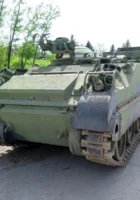
Lla Véhicule de reconnaissance Lynx (fabricant’s name: M113½ Command and Reconnaissance Vehicle, abbr. M113 C&R) is a United States-built tracked reconnaissance armoured fighting vehicle, which was employed by the armed forces of the Netherlands and Canada. Dutch vehicles were exported in the 1990s to Bahrain[1] and Chile, according to SIPRI 35 and 8 vehicles respectively. The M113½ was developed in 1963 as a private venture by FMC Corp., the manufacturer of the M113. It competed with the M114 but the US Army chose the M114 for production. The design was then offered to foreign buyers and gained the name Lynx when purchased by Canada.

Source: Véhicule de reconnaissance Lynx sur Wikipedia

Lire l’article

Vues : 1779