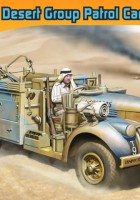
Pikamaa kõrbegrupi patrullauto 2cm kahuriga - DML 7504

Dragon Model

Ref 7504
Tüüp1/72 Sõjavägi
Skaala1/72
Teema

Pikamaa kõrbegrupi patrullauto 2 cm kahuriga

Brändi mudel Draakoni mudel komplekt : Pikamaa kõrberühma patrullauto w/2cm kahur – DML 7504

-Newly tooled LRDG patrol car w/2cm cannon -Sand channel molded on side of vehicle -2cm cannon mounted in rear compartment -Intricate engine grille -Gunner’s seat accurately reproduced -Hand wheels and gun cradle offer great detail definition -Accurately shaped front fenders w/details -Well-defined wheels w/authentic tire tread pattern -Wheels are produced in separate parts -Slide-molded chassis -Delicate spade reproduced -Lee-Enfield mounted besides driver’s cab -Rolled tarpaulins w/detachable brackets fitted on front fenders -Detailed dashboard & driver’s compartment -POW cans included

Long Range Desert Group (LRDG) oli väga tõhus üksus, mis rändas Teise maailmasõja ajal Põhja-Aafrikas vaenlase liinide taga kaugele. See kogus luureandmeid, teostas luuret ja korraldas rünnakuid 1940. aasta keskpaigast kuni 1943. aasta aprillini. Ometi ei ületanud eliitüksus kunagi korraga 350 meest. Kõrbes edukaks läbimiseks kasutas LRDG selliseid sõidukeid nagu kaherattaveoline veoauto. Veok võeti kasutusele 1942. aasta märtsis ja need vastupidavad sõidukid kandsid liivakanaleid, kanistreid, päikesekompassi, mõnikord juhtmevaba, täiustatud radiaatori jahutussüsteemi ja madala rõhuga kõrberehve. Nad olid varustatud selliste relvadega nagu Lewise relvad, Vickersi keskmised kuulipildujad ja Vickers K. Mõned olid varustatud isegi 2 cm suurtükkidega, mis olid Itaalia vägedelt vangi võetud. See oli 20 mm õhutõrjerelv, mida Itaalia kasutas laialdaselt Teises maailmasõjas. Muidugi võis 330 kg kaaluvat relva kasutada ka maapealsete sihtmärkide vastu.

Allikas: Dragon

Jätka lugemist

Views : 1167

RAF gladiaator - HOBI BOSS 80289

Hobiboss

Teema

RAF Gladiator

Skaala1/72
Ref80289

Brändi mudel HobbyBoss komplekt : RAF Gladiator – HOBBY BOSS 80289

Funktsioonid : The kit consists of over 20 parts, includes 1 clear windscreen/canopy

It was the RAF’s last biplane fighter aircraft and was rendered obsolete by newer monoplane designs even as it was being introduced. Though often pitted against more formidable foes during the early days of the Second World War, it acquitted itself reasonably well in combat.

Allikas: Hobiboss

Jätka lugemist

Vaatamisi : 856

IL-2M3 ründelennuk - HOBBY BOSS 80285

Hobiboss

Teema

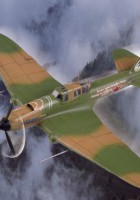
IL-2M3 rünnaku lennukid

Skaala1/72
Ref80285

Brändi mudel HobbyBoss komplekt : IL-2M3 Attack Aircraft – HOBBY BOSS 80285

Funktsioonid : The kit consists of over 30 parts, includes 1 clear windscreen/canopy

2007 Iljušin IL-2 Sturmovik oli Nõukogude Liidu ründelennuk Teises maailmasõjas. Konstrueeritud soomustatud madala taseme lähedase toetusega õhusõidukina, mis on võimeline vaenlase armoreid ja muid maapealseid sihtmärke lüüa. Esmakordselt lendas 12. oktoobril 1940 prototüübina TsKB-57, lennuk alustas tootmist 1941. aasta märtsis ja tuli kasutusele mais. Kokku ehitati 36 163. Sturmovik mängis olulist rolli Ida-Frontil, kuulsad hüüdnimed kui "Must surm" .

Allikas: Hobiboss

Jätka lugemist

Vaadatud : 1118

Nõukogude T-26 kergejalaväe tank Mod.1935 - HOBBY BOSS 82496

Hobiboss

Skaala1/35
Ref82496
Teema

Nõukogude T-26 kergejalaväe tank Mod.1935

Brändi mudel HobbyBoss komplekt : Soviet T-26 Light Infantry Tank Mod.1935 – HOBBY BOSS 82496

Funktsioonid : The kit consists of over 970 parts, multi-directional slide molded lower hull w/fine detail, 240 individual track links, photo-etched parts included

2007 T-26 tank was a Soviet light infantry tank used during many conflicts of the 1930s as well as during World War II. It was a development of the British Vickers 6-Ton tank and is widely considered one of the most successful tank designs of the 1930s. It was produced in greater numbers than any other tank of the period, with more than 11,000 produced. During the 1930s, the USSR developed approximately 53 variants of the T-26, including other combat vehicles based on its chassis. Twenty-three of these were mass-produced. The T-26 was used extensively in the armies of Spain, China and Turkey. In addition, captured T-26 light tanks were used by the Finnish, German, Romanian and Hungarian armies.

Allikas: Hobiboss

Jätka lugemist

Vaadatud : 1527

Pz.Kpfw. VI Tiger I - HOBBY BOSS 82601

Hobiboss

Skaala1/35
Ref82601
Teema

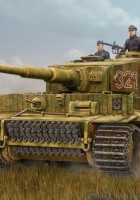
Pz.Kpfw. VI Tiiger I

Brändi mudel HobbyBoss komplekt : Pz.Kpfw. VI Tiger I – HOBBY BOSS 82601

Funktsioonid : the kit is a simplified version consists of over 460 parts

Panzerkampfwagen VI Tiger Ausf.E, sageli lühendatud Tigeriks. See oli vastus ootamatult hirmuäratavale Nõukogude soomusele, mida kohtati teljeriikide sissetungi esimestel kuudel Nõukogude Liitu, eriti T-34 ja KV-1. Tiger I on esimene tank, millele paigaldatakse 88 mm suurtükk, selle esialgses soomustatud lahingumasinale mõeldud versioonis, mis oma Flak-versioonis oli varem näidanud oma tõhusust nii õhu- kui ka maapealsete sihtmärkide vastu. Sõja käigus nägin Tiiger I lahingut kõigil Saksa lahingurindel. Tavaliselt kasutati seda iseseisvates tankipataljonides, mis osutusid üsna hirmuäratavaks. Kuigi paljud vastased kartsid Tiigrit I, oli see ülekonstrueeritud, kasutas kalleid ja töömahukaid materjale ja tootmismeetodeid ning selle tootmine oli aeganõudev. 1942. aasta augustist kuni 1944. aasta augustini ehitati ainult 1,347.

Allikas: Hobiboss

Jätka lugemist

Vaadatud : 3367

Israel Merkava ARV - HOBBY BOSS 82457

Hobiboss

Skaala1/35
Ref82457
Teema

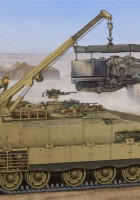
Israel Merkava ARV

Brändi mudel HobbyBoss komplekt : Israel Merkava ARV – HOBBY BOSS 82457

Funktsioonid : The kit consists of over 1070 parts – Multi-directional slide moulded lower hull and upper hull – 216 individual tracks links – Photo-etched parts included

One of the two types of Merkava-based armoured recovery vehicles being trialed. This is the variant with the lighter lift capacity. Although officially built upon the hull of a Merkava 3,this model seems to have many of the characteristics of the Merkava 4. Note the characteristic Merkava 4 style engine exhaust and glacis plate. The machine is fitted with Merkava 3 style tracks. Also note the type of grid armour for the side skirts characteristic of the Merkava 4. Note the two FN 7.62mm machine guns for crew protection.

Allikas: Hobiboss

Jätka lugemist

Vaadatud : 1162

Nõukogude T-64B MOD 1975 - Trompet 01581

Trumpeter

Ref 01581
TüüpMudelikomplekt
Skaala1/35
Teema

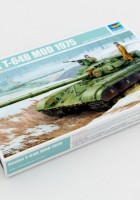
Nõukogude T-64B MOD 1975

Brändi mudel Trumpeter komplekt: Soviet T-64B MOD 1975 – Trumpeter 01581.

Features : The kit consists of over 550 parts -the kit w/refined detail -multi-slide moulded lower hull -plastic tracks links -Included Photo-etched parts

2007 T-64 was conceived in Kharkov as the next-generation main battle tank by Alexander A. Morozov, the designer of the T-54. A revolutionary feature of the T-64 is the incorporation of an automatic loader for its 125-mm gun,allowing a crewmember’s position to be omitted, and helping to keep the size and weight of the tank down,and the T-64B of 1976 would be able to fire a guided antitank missile through its gun barrel. The T-64 would be used only by the Soviet Army and never exported, unlike the T-54/55. It was superior to these tanks in most qualitative terms, until the introduction of the T-72B model in 1985. The tank equipped elite and regular formations in Eastern Europe and elsewhere, the T-64A model being first deployed with East Germany’s Group of Soviet Forces in Germany (GSFG) in 1976, and some time later in Hungary’s Southern Group of Forces (SFG). By 1981 the improved T-64B began to be deployed in East Germany and later in Hungary.

Source: Trumpeter

Jätka lugemist

Views : 1017

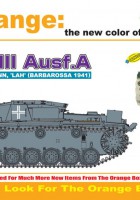
StuG.III Ausf.A, Michael Wittmann, 'LAH' (Barbarossa 1941) - Cyber-Hobby 9143

Küber-hobi

Ref 9143
TüüpMudelikomplekt
Skaala1/35
Teema

StuG.III Ausf.A, Michael Wittmann, ‘LAH’ (Barbarossa 1941)

Brändi mudel Küber-hobi komplekt : StuG.III Ausf.A, Michael Wittmann, ‘LAH’ (Barbarossa 1941) – Cyber-Hobby 9143.

Allikas: Cybber Hobby

The Sturmgeschütz III (StuG III) assault gun was Germany’s most produced armoured fighting vehicle during World War II. It was built on the chassis of the proven Panzer III tank. Initially intended as a mobile, armoured light gun for infantry support, the StuG was continually modified and was widely employed as a tank destroyer.

Allikas: Vikipeedia

Jätka lugemist

Vaadatud : 1437

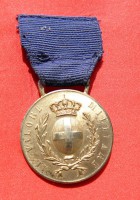
Medal "Gold Medal of Military Valor"

Italy

TypeMilitary decoration
EligibilityJunior officers and soldiers
Awarded forDeeds of outstanding gallantry in war
Established21 May 1793
Total awardednc

The Gold Medal of Military Valor is an Italian medal established on 21 May 1793 by King Victor Amadeus III of Sardinia “….per bassi ufficiali e soldati che avevano fatto azioni di segnalato valore in guerra” (for deeds of outstanding gallantry in war by junior officers and soldiers). The face of the medal displayed the profile of the king, and on its reverse was a flag decoration and the words “al valore” (for valor). On 14 August 1815, Victor Emmanuel I of Sardinia replaced it with the Military Order of Savoy (“l’Ordine militare di Savoia”), now known as the Military Order of Italy. Charles Albert of Sardinia revived it on March 26, 1833, and added to it the Silver and Bronze medals. These had, on their faces, the coat of arms of Savoy with laurel branches, the royal crown, and the words “al valor militare” (for military valor). On the reverse were two laurel branches enclosing the name of the decorated soldier, and the place and date of the action. With the proclamation of the Republic on June 2, 1946, the coat of arms of Savoy was replaced with the emblem of the Italian Republic

Allikas: Vikipeedia

Jätka lugemist

Vaadatud : 1312

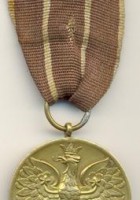
Medal "Army Medal for War 1939-45"

Poola

Tüüp Kampaania medal
AbikõlblikkuseAll members of the Polish Ground Forces
Auhinnatud6 months of meritorious service
Kehtestatud 3 July 1945
Autasustatud kogusummanc

The Army Medal for War 1939-45 (Polish: Medal Wojska za Wojne 1939-45) was created in 1945 by the Polish government in Exile (in London) to reward members of the Polish ground forces for service during World War II. The eligibility criteria were: six months of operational service during World War II, or 12 months in a non-operational role. The medal could be conferred up to four times, although for a subsequent award the period of service was doubled.

Allikas: Vikipeedia

Jätka lugemist

Vaadatud : 876