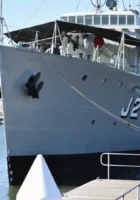
HMAS Castlemaine

Hrad HMAS (J244)

ZeměAustrálie
TypKorveta
FotografiiVladimir Jakubov
VyhledejteMelbourne, Austrálie
PopisAlbum 89 fotografie procházka kolem «HMAS Castlemaine (J244)»

Fotogalerie Hrad HMAS (J244), HMAS Castlemaine (J244/M244/A248), named for the city of Castlemaine, Victoria, was one of 60 Bathurst-class corvettes constructed during World War II, and one of 36 initially manned and commissioned solely by the Royal Australian Navy (RAN). Launched in 1941 and commissioned in 1942, Castlemaine operated during World War II in the waters of Australia, New Guinea, and Timor. She remained in service until 1945, when she was decommissioned into reserve and converted into an immobilised training ship. In 1973, Castlemaine was presented to the Maritime Trust of Australia for conversion of a museum ship. She is one of two surviving examples of the Bathurst class, the other being HMAS Whyalla.

Zdroj: HMAS Castlemaine (J244) na Wiki

Pokračovat ve čtení

Počet zobrazení: 2992

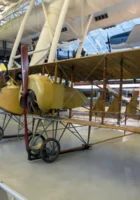
Caudron G.4

Caudron G.4

ZeměFrancie
Typdvojplošník
FotografiiVladimir Jakubov
VyhledejteNárodní letecké a kosmické muzeum – Udvar-Hazy Center, Chantilly
PopisAlbum 84 fotografie procházky «Caudron G.4»

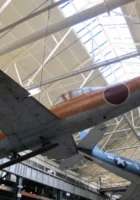
Fotogalerie Caudron G.4, The Caudron G.4 was a French biplane with twin engines, widely used during World War I as a bomber aircraft. It was designed by René and Gaston Caudron as an improvement over their single engined Caudron G.3. The aircraft employed wing warping for banking. The first G.4 was built in 1915, and it was manufactured in France, England and Italy. The Caudron G.4 was used as a reconnaissance bomber into the heart of Germany. Later, when Germany developed a fighter force, the aircraft had to be used for night bombings.

Zdroj: Caudron G.4 na Wiki

Pokračovat ve čtení

Zobrazení: 5566

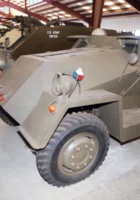
M5359 Praga

M53/59 Praga

ZeměČeskoslovensku
TypSamořídící protiletadlové dělo
Vyrobené50.
Postaven900+

M53/59 Praga is a Czechoslovak self-propelled anti-aircraft gun developed in the late 1950s. It consists of a heavily modified Praga V3S six-wheel drive truck chassis, armed with a twin 30 mm AA autocannon mounted on the rear for which the vehicle typically carries 900 rounds of ammunition, each gun being gravity fed from distinctive 50 round magazines. The vehicle has an armoured cabin. In Czechoslovakia it was known as Praga PLDvK vz. 53/59 – “Ještěrka” (PLDvK Model 53/59 – “Lizard”[2]). PLDvK stands for Protiletadlový dvojkanón = Anti-aircraft twin-gun.

Zdroj: M53/59 Praga na Wiki

Pokračovat ve čtení

Zobrazení : 4192

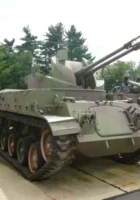
M42A1 Duster

M42A1 Duster

ZeměSPOJENÉ STÁTY
TypSamořídící protiletadlové dělo
FotografiiVladimir Jakubov
VyhledejteVojenské muzeum Motts
PopisAlbum 152 fotografie procházka kolem «M42A1 Duster»

Fotogalerie M42A1 Duster, The M42 40 mm Self-Propelled Anti-Aircraft Gun, or “Duster,” is an American armored light air-defense gun built for the United States Army from 1952 until December 1959, in service until 1988. Production of this vehicle was performed by the tank division of the General Motors Corporation. It used components from the M41 light tank and was constructed of all-welded steel.

Zdroj: M42A1 Duster na Wiki

Pokračovat ve čtení

Počet zobrazení: 4393

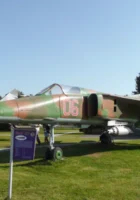
Mig-27K

Mig-27K

ZeměURSS
TypPozemní útočná letadla
FotografiiVladimir Jakubov
VyhledejteLetecké muzeum Minsk-Borovaya
PopisAlbum 175 fotografie procházky «Mig-27K»

Fotogalerie Mig-27K, The Mikoyan MiG-27 (Russian: Микоян МиГ-27; NATO reporting name “Flogger-D/J”) is a variable-geometry ground-attack aircraft, originally built by the Mikoyan design bureau in the Soviet Union and later license-produced in India by Hindustan Aeronautics as the Bahadur (“Valiant”). It is based on the Mikoyan-Gurevich MiG-23 fighter aircraft, but optimized for air-to-ground attack. Unlike the MiG-23, the MiG-27 did not see widespread use outside Russia, as most countries opted for the MiG-23BN and Sukhoi Su-22 instead. It currently only remains in service with the Indian, Kazakh and Sri Lankan Air Forces in the ground attack role. All Russian and Ukrainian MiG-27s have been retired.

Zdroj: Mig-27K na Wiki

Pokračovat ve čtení

Počet zobrazení: 6058

KugishoYokosuka K-1 Ohka

Kugisho/Jokosuka K-1 Ohka

ZeměJaponsko
TypRaketový pohon řízený člověkem
První letŘíjen 1944
Postaven852

Fotogalerie Kugisho/Jokosuka K-1 Ohka, The Yokosuka MXY-7 Ohka was a purpose-built, rocket powered human-guided anti-shipping kamikaze attack plane employed by Japan towards the end of World War II. Ohka K-1: bezmotorová cvičná verze s vodní zátěží namísto hlavice a motorů, která poskytuje pilotům zkušenosti s manipulací. 45 jich postavil Dai-Ichi Kaigun Koku Gijitsusho

Zdroj: Kugisho/Yokosuka K-1 Ohka na Wiki

Pokračovat ve čtení

Zobrazení : 2611

Gloster Meteor T.7

Gloster Meteor T.7

ZeměUk
TypStíhací letouny
FotografiiVladimir Jakubov
VyhledejteAustralské národní letecké muzeum
PopisAlbum 71 fotografie procházky «Gloster Meteor T.7»

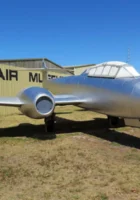
Fotogalerie Gloster Meteor T.7, The Gloster Meteor was the first British jet fighter and the Allies’ only operational jet aircraft during the Second World War. The Meteor’s development was heavily reliant on its ground-breaking turbojet engines, pioneered by Sir Frank Whittle and his company, Power Jets Ltd. Development of the aircraft itself began in 1940, although work on the engines had been under way since 1936. The Meteor first flew in 1943 and commenced operations on 27 July 1944 with No. 616 Squadron RAF. Nicknamed the “Meatbox”, the Meteor was not a sophisticated aircraft in its aerodynamics, but proved to be a successful combat fighter. Gloster’s 1946 civil Meteor F.4 demonstrator G-AIDC was the first civilian-registered jet aircraft in the world. Meteor T.7: Two-seat trainer variant of the F.4, company prototype first flew 19 March 1948, 640 production aircraft for the Royal Air Force and the Royal Navy (43) and 72 for export (Belgium, Brazil, Denmark, Egypt, France, Israel, Netherlands). Avions Fairey modified 20 Belgian Air Force F.4s to T.7 standard.

Zdroj: Gloster Meteor T.7 na Wikipedii

Pokračovat ve čtení

Zobrazení : 3728

Dassaultův etendard IV M

Dassaultův etendard IV M

ZeměFrancie
TypStíhací letouny
Úvod1962
Důchodu1991

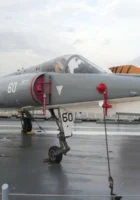
Fotogalerie Dassaultův etendard IV M, The Dassault Étendard IV was a subsonic carrier-borne strike fighter aircraft, which entered service with the French Navy in 1962. It served as the basis for the more advanced Dassault-Breguet Super Étendard. During the 1970s, it had been intended to replace the Étendard IV with a navalised version of the SEPECAT Jaguar, designated as the Jaguar M, however development of the Jaguar M was cancelled and shortly replaced by the Super Étendard. The Étendard IV was progressively withdrawn during the 1980s and finally retired from service with its sole operator in 1991. Étendard IVM : Single-seat Maritime strike fighter aircraft for the French Navy.

Zdroj: Dassault Etendard IV M na Wikipedii

Pokračovat ve čtení

Zobrazení: 6035

Typ 69

Typ 69 (irácký)

ZeměČína-Iráčan
RoliHlavní bojový tank
V provozu1982–současnost
PostavenNeznámé

Type 69 (čínština: 69式; pinyin: Liùjiǔ shì) a Typ 79 (čínština: 79式; pinyin: Qījiǔ shì) jsou čínské hlavní bojové tanky. Oba vývojy typu 59 (založené na sovětském T-54A) byly prvními hlavními bojovými tanky vyvinutými nezávisle Čínou.Jejich linie je vidět přes zřetelnou mezeru mezi prvním a druhým silničním kolem. Mezi další vylepšení patřil nový motor, balistické počítače a laserové dojezdové vyhledávače. Pokročilejší Type 79 byl vybaven 105mm puškovým dělem, které bylo také vidět na pozdějším tanku Type 88. Irák: -Type 69-QM – Also known as T-55B inside the Iraqi Army. Type 69-II with standard 100 mm rifled main gun, armour reinforced with layer armour on the front glacis, an observation mast and, on some units, a 60 mm mortar. Command vehicles often fitted with blocks of appliqué spaced armour, similar to the so-called Enigma T-55s. Produced 1986–1988. -Type 69-QM1 – Type 69-II upgraded with NATO standard 105 mm rifled gun and laser range-finder. Produced 1984–1988. -Type 69-QM2 – Type 69-II upgraded with Warsaw Pact standard 125 mm (L80) smoothbore main gun and laser range-finder. Produced 1986–1991.

Zdroj: Typ 69 (Iráčan) na Wikipedii

Pokračovat ve čtení

Views : 8830

Typ 59

Typ 59 (NVA)

ZeměČína
TypHlavní bojový tank
FotografiiAzrael Havran
TitulTyp 59 (NVA) Kolem
PopisAlbum 46 fotografie procházka kolem «Typ 59 (NVA)»

Fotogalerie Typ 59 (NVA), The Type 59 (Chinese: 59式; pinyin: Wǔjiǔ shì; industrial designation: WZ-120) main battle tank is a Chinese-produced version of the Soviet T-54A tank, the earliest model of the ubiquitous T-54/55 series. The first vehicles were produced in 1958 and it was accepted into service in 1959, with serial production beginning in 1963. Over 10,000 of the tanks were produced by the time production ended in 1980 with approximately 5,500 serving with the Chinese armed forces. The tank formed the backbone of the Chinese People’s Liberation Army until the early 2000s (decade) with an estimated 5,000 of the later Type 59-I and Type 59-II variants in service in 2002.

Zdroj: Type 59 (NVA) na Wikipedii

Pokračovat ve čtení

Zobrazení: 3556