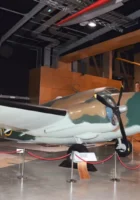
Lockheed Hudson Mk.III

Lockheed Hudson Mk.III

CountryUSA
TypeLight bomber
Period1938–1943
Built2941

The Lockheed Hudson was an American-built light bomber and coastal reconnaissance aircraft built initially for the Royal Air Force shortly before the outbreak of the Second World War and primarily operated by the RAF thereafter. The Hudson was the first significant aircraft construction contract for the Lockheed Aircraft Corporation—the initial RAF order for 200 Hudsons far surpassed any previous order the company had received. The Hudson served throughout the war, mainly with Coastal Command but also in transport and training roles as well as delivering agents into occupied France. They were also used extensively with the Royal Canadian Air Force’s anti-submarine squadrons and by the Royal Australian Air Force.

Source: Lockheed Hudson Mk.III on Wiki

Continue reading

Views : 5477

General Atomics MQ-1 Predator

General Atomics MQ-1 Predator

CountryUSA
TypeRemotely piloted aircraft
Period1995–present
Built360

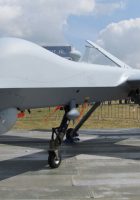
The General Atomics MQ-1 Predator is an American remotely piloted aircraft (RPA) built by General Atomics and used primarily by the United States Air Force (USAF) and Central Intelligence Agency (CIA). Initially conceived in the early 1990s for aerial reconnaissance and forward observation roles, the Predator carries cameras and other sensors but has been modified and upgraded to carry and fire two AGM-114 Hellfire missiles or other munitions. The aircraft, in use since 1995, has seen combat in war in Afghanistan, Pakistan, the NATO intervention in Bosnia, Serbia, Iraq War, Yemen, Libyan civil war, the intervention in Syria, and Somalia.

Source: General Atomics MQ-1 Predator on Wiki

Continue reading

Views : 3039

Schützenpanzer SPz 11-2 Kurz

CountryGermany
TypeArmored reconnaissance vehicle
Period1958-1982
Built2374+

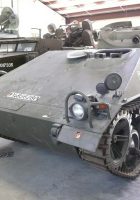
The Schützenpanzer SPz 11-2 Kurz armored reconnaissance vehicle was developed for the West German army and was a minor modification of a French designed vehicle (Hotchkiss SP1A). During the period between 1958 and 1962, the West German army received some 2,374 of these light armoured vehicles with the SPz 11-2 Kurz being developed as the reconnaissance version. The SPz 11-2 served in cannon platoons of armored infantry battalions until 1974 and remained in service as a reconnaissance vehicle until 1982. The SPz 11-2 was replaced in the reconnaissance role by the Spähpanzer Luchs. The SPz 11-2 saw service with the West Germany army only.

Source: Schützenpanzer SPz 11-2 Kurz on Wiki

Continue reading

Views : 3565

Hughes OH-6A

CountryUSA
TypeLight Observation Helicopter
Period1965-present
Built1420

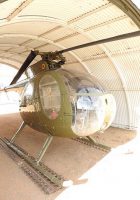
The Hughes OH-6 Cayuse (nicknamed “Loach”, after the requirement acronym LOH — Light Observation Helicopter) is a single-engine light helicopter with a four-bladed main rotor used for personnel transport, escort and attack missions, and observation. Hughes Helicopters also developed the Model 369 as a civilian helicopter, and the Hughes Model 500, currently produced by MD Helicopters as the MD 500.

Source: Hughes OH-6A on Wiki

Continue reading

Views : 4254

Piasecki HU-21B

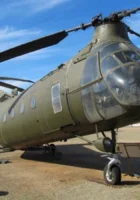
Piasecki HU-21

CountryUSA
TypeCargo helicopter
Period1952-1967
ManufacturerPiasecki Helicopter

The Piasecki H-21 Workhorse/Shawnee is an American helicopter, the fourth of a line of tandem rotor helicopters designed and built by Piasecki Helicopter (later Boeing Vertol). Commonly called “the flying banana”, it was a multi-mission helicopter, utilizing wheels, skis, or floats. The H-21 was originally developed by Piasecki as an Arctic rescue helicopter. The H-21 had winterization features permitting operation at temperatures as low as −65 °F (−54 °C), and could be routinely maintained in severe cold weather environments.

Source: Piasecki HU-21 on Wiki

Continue reading

Views : 5286

37mm Anti-aircraft gun

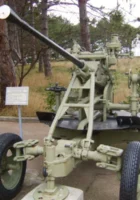
37mm Anti-aircraft gun

CountrySoviet Union
TypeAir defense gun
Period1939-1945
Built20.000

37 mm automatic air defense gun M1939 (61-K) (Russian: 37-мм автоматическая зенитная пушка образца 1939 года (61-К)) was a Soviet 37 mm caliber anti-aircraft gun developed during the late 1930s and used during World War II. The land based version was replaced in Soviet service by the ZSU-57-2 during the 1950s. Guns of this type were successfully used throughout the Eastern Front against dive bombers and other low- and medium-altitude targets. It also had some usefulness against lightly armored ground targets. Crews of the 37 mm AD guns shot down 14,657 Axis planes. The mean quantity of 37 mm ammunition to shoot down one enemy plane was 905 rounds.

Source: 37mm M1939 on Wiki

Continue reading

Views : 5737

North American T-2C Buckeye

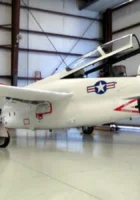
North American T-2A Buckeye

CountryUSA
First flight31 January 1958
RoleTraining aircraft
Built529

The North American T-2 Buckeye was the United States Navy’s intermediate training aircraft, intended to introduce U.S. Navy and U.S. Marine Corps Student Naval Aviators and Student Naval Flight Officers to jets. It entered service in 1959, and was replaced by the McDonnell Douglas T-45 Goshawk in 2008.

Source: North American T-2A Buckeye on Wiki

Continue reading

Views : 4869

160mm mortar M-160

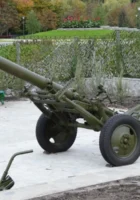
160mm mortar M-160

CountrySoviet Union
PeriodWorld War II
TypeMortar

The Soviet 160 mm Mortar M1943 was a smoothbore breech loading heavy mortar which fired a 160 mm bomb. The M1943 (also called the MT-13) was one of the heaviest mortar used by Soviet troops in World War II. Around 535 of these weapons were fielded with Soviet forces during the war. It was replaced in Soviet service after World War II by the M-160 mortar of the same caliber.

Source: 160mm mortar M-160 on Wiki

Continue reading

Views : 6224

Renault AMR 33

Renault AMR 33

CountryFrance
ManufacturerRenault
Produced1933 – 1935
TypeAutomitrailleuse de Reconnaissance

The Automitrailleuse de Reconnaissance Renault Modèle 1933 (AMR 33 or Renault VM) was a French light cavalry tank developed during the Interbellum and used in the Second World War. Developed by Renault from 1932, the type was in 1933 ordered by the French Cavalry; a total of 123 would be built until 1935. The AMR 33 was lightly armed and armoured; though it was very fast for its day, it proved to be a mechanically unreliable vehicle, especially its suspension elements were too weak. It was therefore succeeded by an improved type, the AMR 35.

Source: Renault AMR 33 on Wiki

Continue reading

Views : 2802