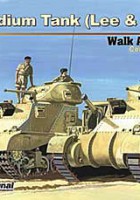
M3 Medium Tank Walk Around - Squadron Signal SS5712

Squadron Signal

SerieAmor Walk Around
RefSS5712
TopicM3 Medium Tank
Periodww2

A book signed Squadron Signal the revue «M3 Medium Tank Walk Around – Squadron Signal SS5712» .

The M3 Medium Tank was designed as an interim answer to European battlefield conditions at the start of World War II. The tank was required to have heavier armor and a gun twice the size of the M2A1. Additionally, plans needed to be ready in 60 days. The solution was the M3’s unconventional design, which features a 75mm main gun mounted in a sponson on the right, front of the hull. The British dubbed their version ‘General Grant’ and named the US Army version the ‘General Lee.’ This book takes a detailed look at the M3 Medium Tank with more than 200 photographs, color profiles and detailed line drawings. Doyle; 80 pages.

Source: Squadron Signal

Continue reading

Views : 736

Squadron Signal - SS5711

Squadron Signal

SerieAmor Walk Around
PeriodSeconde guerre mondiale
RefSS5711
SubjectPre-Standardized Jeep

A book signed Squadron Signal the revue «Pre-Standardized Jeep Color Walk Around – Squadron Signal SS5711» .

Three distinct versions of a reconnaissance car were produced before they were standardized into the World War II-era Jeep. Bantam, Ford and Willys produced different models to win military contracts. Bantam delivered 70 pre-production units in December 1940. Eight of these models featured four-wheel steering. In 1941, the U.S. government ordered 1,500 units from each of the manufacturers. The best qualities of the three models were incorporated into the final standardized Jeep. This book takes a detailed look at Jeep’s early evolution with more than 250 photographs, color profiles and detailed line drawings. Doyle; 80 pages.

Source: Squadron Signal

Continue reading

Views : 1143

GPA/DUKW Color Walk Around - Squadron Signal SS5710

Squadron Signal

SerieAmor Walk Around
RefSS5710
SubjectGPA/DUKW
Periodww2

A book Squadron Signal a revue «GPA/DUKW Color Walk Around – Squadron Signal SS5710» .

The US used 2 main wheeled amphibians during WWII: the 1/4-ton GPA and the 2-1/2 ton DUKW. Although the former was a Ford Motor Company product and the later carried the label of arch-rival General Motors, the 2 bore a similarity due to their common designer – Roderick Stephens. Despite their shared origins and cutting-edge design, the GPA and DUKW had vastly contrasting careers. Production of the GPA, essentially an amphibious Jeep, ended in 1943, just as the career of the DUKW, a virtual aquatic truck, was on its way to becoming the ‘gold standard’ by which other amphibians are measured to this day. After taking part in the Allied invasion of Sicily in July 1943, the DUKW went on to see action in nearly every other American amphibious landing in WWII and came back to see service during the Korean War as well. Illustrated with 263 high quality photographs, color art, and profiles. Doyle; 80 pages.

Source:Squadron Signal

Continue reading

Views : 806

Squadron Signal 5709 Sdkfz.251 Ausf.D

Squadron Signal

SerieAmor Walk Around
RéfSS5709
SubjectSd.Kfz.251 Color Walk Around
Periodww2

A book signed Squadron Signal the revue «Sd.Kfz.251 Color Walk Around – Squadron Signal SS5708» .

Considered the German Army’s most important armored half-track in WWII, the Sd.Kfz.251 allowed the infantry to keep up with the Heer’s fast armored elements. The vehicle came in 4 models and 23 variants, but the Ausf.D was the most produced model. In fact, Ausf.Ds represented nearly 70 percent of Sd.Kfz.251s built during wartime. The type’s simplified design was the main contributor to this variant being produced in such substantial numbers, and the Ausf.D was the first of the 251s to have stowage bins built into the sides of the half track. This mass-produced, streamlined vehicle truly proved its worth in WWII and saw action on every front. Illustrated with over 150 color photographs, detailed line drawings, and 8 colored profiles. A must have book for the armor, modeling, history, and military enthusiast. Stapfer; 80 pages.

Source: Squadron Signal

Continue reading

Views : 1114

V-100 Commando Color Walk Around - Squadron Signal SS5708

Squadron Signal

SerieAmor Walk Around
RefSS5708
SubjectV-100 Commando
Periodpost-WWII era

A book signed Squadron Signal the revue «V-100 Commando Color Walk Around – Squadron Signal SS5708» .

Cadillac Gage V-100 Commando Color Walk Around. The best-known American armored car of the post-WWII era, the Cadillac Gage Commando – a versatile, amphibious, 4×4 vehicle – still looks modern even though it made its debut in 1962. The V-100 Commando went through numerous changes in light of its extensive and varied experience in reconnaissance, convoy escort, riot control, security, and as a personnel carrier. As it proved its worth to America’s South Vietnamese allies and later to US forces in Southeast Asia, Cadillac Gage introduced one modification after another in response to evolving combat needs. Although US military use of the Commando declined after the end of the Vietnam War, many Commandos were rebuilt and to this day, serve police forces and SWAT teams in Europe and the US, while various armies around the world still use descendents of the combat version. Illustrated with over 200 color photographs plus detailed line drawings; Doyle.80 pages.

Source: Squadron Signal

Continue reading

Views : 557

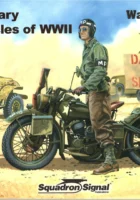
Squadron Signal 5707 US Military Motorcycles of WWII

Squadron Signal

SerieAmor Walk Around
RefSS5707
TopicWWII Motorcycles
Periodww2

A book Squadron Signal the revue «WWII Motorcycles Color Walk Around – Squadron Signal SS5707» .

US Military Motorcycles of WWII Color Walk Around. During WWII, the United States turned to Harley-Davidson and Indian Motorcycle Company to produce military-worthy motorcycles. Additionally, other Allied powers looked to these companies for bikes through the Lend-Lease program. As a result, Harley-Davidson produced the WLA, the U and UA, and the shaft-drive XA. Indian provided the 340-B and the 741, and the shaft-drive 841. While the WLA, U/UA, 340-B, and 741 saw extensive military use, the shaft-drive bikes from both companies never saw combat. The advent of the Jeep took over the motorcycle’s role in military service, and the bikes were relegated to veteran vehicles of the past. Illustrated with over 200 color photographs, 11 black-and-white photographs and color art by Don Greer. David Doyle. 80 pages.

Source: Squadron Signal

Continue reading

Views : 1360

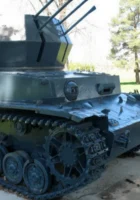
Flakpanzerkampfwagen IV

Flakpanzerkampfwagen IV

CountryGermany
TypeChar antiaérien
DescriptionAlbum of 69 photos walk-around of a «Flakpanzerkampfwagen IV»

The Flakpanzer IV est un char antiaérien allemand de la Seconde Guerre mondiale, qui était utilisé pour protéger les unités blindées. Il a été décliné en quatre versions, Möbelwagen, Wirbelwind, Ostwind et Kugelblitz. En août 1944 est décidé le développement d’un système anti-aérien basé sur le châssis du PzKpfw IV et avec pour armement un canon 43 L/60 de 3,7 cm. Le canon placé dans une tour de six côtés pouvait effectuer une rotation de 360° et par conséquent pouvait donner une protection efficace contre les menaces aériennes. Il fut utilisé dans les unités Flugabwehrzug (pelotons antiaériens) dans les régiments Panzer.

Source: Flakpanzerkampfwagen IV on Wikipedia

Continue reading

Views : 5709

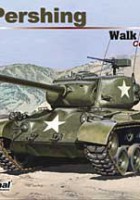
M26 Pershing Color Walk Around - Squadron Signal SS5706

Squadron Signal

SerieAmor Walk Around
RefSS5706
SubjectM26 Pershing
Periodww2

A book from Squadron Signal the book «M26 Pershing Color Walk Around – Squadron Signal SS5706» .

By early 1942, it was apparent that the Sherman tank was no match for its German adversaries. American battle doctrine of the time was that US tanks were not to fight opposing tanks, leaving this to tank destroyer units; however, the German forces refused to adhere to this plan. A number of different models using various chassis, turret, and gun combinations were tested, leading up to the T26 ‘heavy’ tank design. It would be 1945 before this tank evolved into the T26E3 and finally saw combat. The basic design of the M26 – the designation the T26E3 had been given when it was classified ‘standard’ in March 1945 – was to form the basis of a long line of excellent tanks (M46, M47, M48 and M60) that would serve US armed forces for 40 years. Illustrated with 250 photographs, color profiles, and detailed line drawings; Doyle. 80 pages.

Source: Squadron Signal

Continue reading

Views : 1736

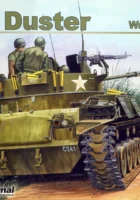
Squadron Signal 5705 M42 Duster

Squadron Signal

SerieAmor Walk Around
RefSS5705
TopicM42 Duster

A book signed Squadron Signal the magazine «M42 Duster Color Walk Around – Squadron Signal SS5705» .

The US Army began accepting deliveries of the M42 in October 1952, when production ended in 1959, approximately 3,700 units delivered. By the late ’60s, the Duster’s limits seemed to have been reached. The lack of radar tracking system meant the M42 was a ‘fair weather’ shooter against low, slow targets; it just could not keep pace with the new generation of Soviet jet aircraft. As American involvement in Vietnam increased, 3 battalions of Dusters were sent to South Vietnam – initially for anti-aircraft duties, but with clear skies over the South, the M42 was usefully employed as convoy escort, perimeter and base security, and direct fire support. This book takes a detailed look at the M42 Duster with more than 200 photographs, color profiles and detailed line drawings; Doyle. 80 pages.

Source: Squadron Signal

Continue reading

Views : 1421

Squadron Signal 5704 M2 M3 Half-Track

Squadron Signal

SerieAmor Walk Around
RéfSS5704
TopicM2/M3 Half Track

A book signed Squadron Signal the magazine «M2/M3 Half Track Walk Around – Squadron Signal SS5704» .

Provides an in-depth look at the history and variants of the WW II US personnel carrier. Includes full color profiles, B&W line art, technical data, dozens of full color photos, and B&W photos. Mesko. 80 pgs.

Source: Squadron Signal

Continue reading

Views : 1126