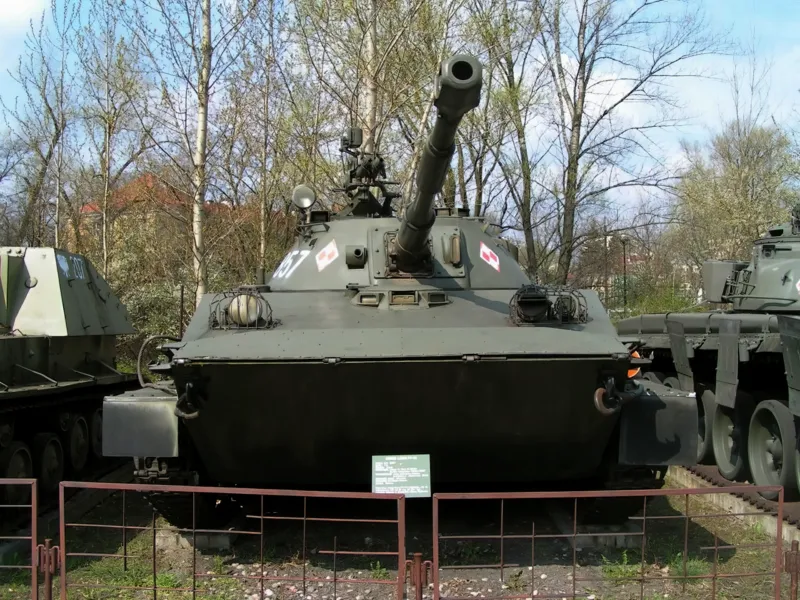
PT-76 | |
|---|---|
| Zemlja | URSS |
| Tip | Char léger amphibie |
| Masse au combat | 15 tonnes |
Galerie photo sur un char PT-76, Le PT-76 qui était un char soviétique de la gamme “léger amphibie” fut dans sa catégorie surement le plus répandu. A l’instart de ses homologues l’AMX-13 français et le M113 américain son châssis a été utilisé comme base à de multiples dérivés d’engins militaires. La production du PT-76 a commencé pendant l’année 53 puis ce tank a été profondément modifié en 59, il sera nommé PT-76B. Sa production (7000 exemplaires du PT-76 ont été fabriqués) s’arrête en 1963.
Izvor: PT-76 sur Wkipedia
| PT-76 – WalkAround | |
|---|---|
| Fotograf | Nepoznato |
| Lokalizacija | Nepoznato |
| Fotografije | 81 |


| PT-76 | |
|---|---|
| Fotografiši | Viktor Krestinin |
| Lokalizacija | Batey ha-Osef Museum |
| Opis | Album 63 walk-around fotografije tenka PT-76 |
| PT-76 Walk Around | |
|---|---|
| Fotografiši | Andrej Nikolajev |
| Lokalizacija | Nepoznat |
| Opis | Album 32 walk-around photos of the PT-76 |
| PT-76 Walk Around | |
|---|---|
| Fotograf | Nepoznato |
| Lokalizacija | Nepoznato |
| Fotografije | 53 |
| PT-76 Walk Around | |
|---|---|
| Fotograf | Nepoznato |
| Lokalizacija | Nepoznato |
| Fotografije | 13 |
| PT-76B Walk Around | |
|---|---|
| Fotograf | Nepoznato |
| Lokalizacija | Nepoznato |
| Fotografije | 14 |
Pogledajte i:


Primary Role and Design Philosophy
The PT-76 (from Plavayushchiy Tank, meaning “Floating Tank”) is a Soviet light amphibious tank introduced in the early 1950s. It was designed primarily for reconnaissance and fire support for Soviet Naval Infantry and ground forces crossing major water obstacles.
Its overall design prioritizes low weight and a spacious hull to ensure the necessary buoyancy for full amphibious operations without extensive preparation.
Mobility and Amphibious Capability
The ability to operate in water is the tank’s defining feature:
- Water Propulsion: The tank is propelled through the water by two powerful hydro-jets located at the rear of the hull. Steering in the water is achieved by opening and closing covers over the jet outlets.
- Preparation: To swim, the crew only needed to raise a trim vane on the front glacis plate and switch on bilge pumps.
- Speeds: It achieves a modest road speed of around 44 km/h on land, but its water speed is crucial, reaching approximately 10.2 km/h.
- Chassis: It uses a torsion-bar suspension and six large, hollow road wheels on each side, which also contribute to buoyancy.
Armament and Protection
The firepower and armor were a compromise to achieve amphibious capability:
| Feature | Detail |
|---|---|
| Glavno naoružanje | 76.2 mm D-56T rifled gun (later D-56TS with stabilization in the PT-76B variant). |
| Ammunition | Carries 40 rounds, including Fragmentation-HE, AP-T, and crucial HEAT (High-Explosive Anti-Tank) rounds for engaging heavier armor. |
| Sekundarno naoružanje | 7.62 mm coaxial machine gun. |
| Armor | The hull and turret armor is made of thin, welded steel, providing protection only against small arms fire and shell fragments, but not against heavy machine guns or anti-tank weapons. |
The tank has a crew of three: the Driver, and the Commander/Gun
Views : 5750