San Chamond | |
|---|---|
| Paese | Francia |
| digitare | Carro medio |
| Un sacco | 23 tonnellate |
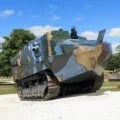
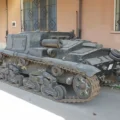
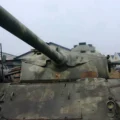
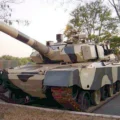
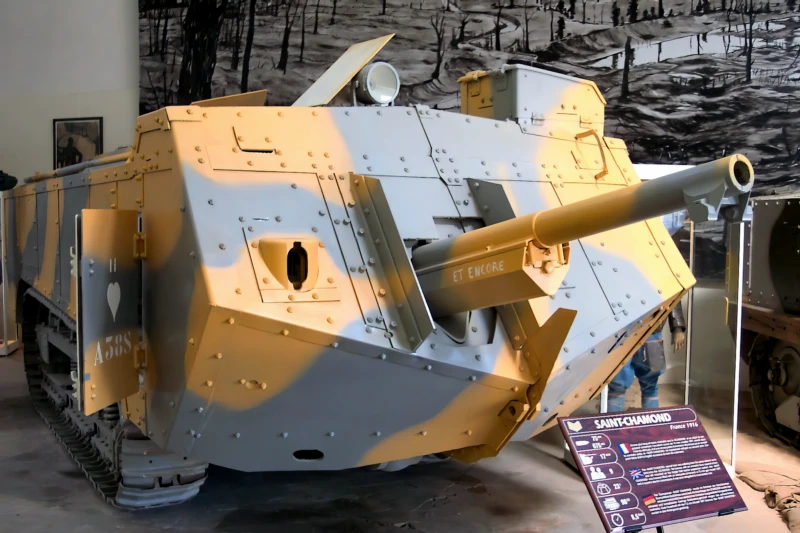
Le cantone di Saint-Chamond fu il secondo carro armato pesante francese della prima guerra mondiale, con 400 esemplari prodotti dall'aprile 1917 al luglio 1918. Sebbene non sia un carro armato secondo la definizione attuale, è generalmente accettato e descritto come tale nei resoconti dello sviluppo iniziale del carro armato. Nato dalla rivalità commerciale esistente con i produttori del carro armato Schneider CA1, il Saint-Chamond era un design sottodimensionato e fondamentalmente inadeguato. La sua principale debolezza erano le tracce "bruco" di Holt. Erano troppo corti rispetto alla lunghezza del veicolo e al peso elevato (23 tonnellate). I modelli successivi, tuttavia, tentarono di correggere alcuni dei difetti originali del carro armato installando scarpe da cingolate più larghe e più forti, una corazza frontale più spessa e il più efficace cannone da campo Mle 1897 da 75 mm. Complessivamente furono costruiti 400 carri armati Saint-Chamond, tra cui 48 carri armati Caisson disarmati. I carri armati saint-chamond rimasero impegnati in varie azioni fino alla fine dell'estate del 1918, diventando tardivamente più efficaci poiché il combattimento si era spostato fuori dalle trincee e su terreno aperto. Alla fine, tuttavia, i carri armati Saint-Chamond furono completamente sostituiti da carri pesanti britannici importati.
fonte: Saint Chamond su Wkipedia
| Saint Chamond – WalkAround | |
|---|---|
| Fotografo | Unknow |
| Localizzazione | Inconsapevole |
| Foto | 68 |


| Saint Chamond – WalkAround | |
|---|---|
| Fotografo | Unknow |
| Localizzazione | Inconsapevole |
| Foto | 47 |
Overview and Context
The Saint-Chamond was the second French heavy assault tank to enter service during World War I, with approximately 400 units produced between 1917 and 1918. Born out of industrial rivalry with the manufacturers of the first French tank (the Schneider CA1), it was an ambitious but deeply flawed design.
Its primary goal was to bring the firepower of a potent artillery piece, the French 75 mm field gun, directly against enemy trenches and fortifications.
Design e specifiche
- Shape and Hull: It had a long, boxy superstructure with significant overhangs at both the front and rear of the vehicle, extending well beyond the relatively short, narrow tracks. This gave it a massive, ungainly silhouette.
- Armamento principale: A long-barreled 75 mm gun (either the Saint-Chamond L12C TR or the standard Mle 1897 field gun in later versions) was rigidly mounted in the front of the hull, offering only a very limited traverse.
- Secondary Armament: Four 8 mm Hotchkiss machine guns, one mounted in each side (front, rear, left, right).
- Propulsion: The tank used a complex and innovative petrol-electric transmission system (Crochat-Colardeau). A 90 hp Panhard engine drove a generator, which in turn powered two electric motors linked separately to each track. This allowed for smooth steering but was heavy and prone to overheating and mechanical issues.
- Crew: The tank typically required a large crew of eight to nine men.
- Armatura: Initially thin, with maximum armor plating of around 11.5 mm on the front and 8.5 mm on the sides. Later models increased side armor to 17 mm and added a spaced layer to the front to resist German armor-piercing bullets.
Combat Performance and Flaws
Despite its powerful main gun, the Saint-Chamond was plagued by critical operational deficiencies:
- Trench Crossing: The overly long hull combined with the relatively short track length and heavy forward weight caused the tank’s nose to violently dig into the ground or get irrevocably stuck in trenches and shell craters, making it notoriously poor for traversing the scarred terrain of the Western Front.
- Underpowered: The 90 hp engine was inadequate for the tank’s operational weight of around 23 metric tons, severely limiting its cross-country speed and agility (top speed was only about 8-12 km/h).
- Vulnerable: Its thin side armor left the crew vulnerable to heavy machine gun fire, a major issue that was only partially addressed in late-production models.
The Saint-Chamond remained in service until late 1918, mostly performing as a pistola semovente or being converted into unarmed supply/recovery vehicles, as it was eventually superseded by the more reliable and tactically superior Renault FT light tank and imported British heavy tanks.
Visualizzazioni : 4884