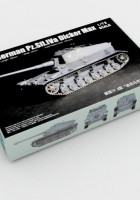
Alemán Pz.Sfl.Iva Dicker Max - Trompetista 07108

Trumpeter

Ref 07108
TipoKit de modelo
Escala1/72
Tema

German Pz.Sfl.Iva Dicker Max

Un modelo de la marca Trumpeter el kit: German Pz.Sfl.Iva Dicker Max – Trumpeter 07108.

Features : The kit consists of over 100 parts -detailed hull and turret

En su informe del año fiscal 1938, Krupp reveló que comenzó con el diseño de un K L/52 Selbstfahrlafette de 105 mm. La máquina era famosa como "Dicker max". Estaba armado con el K18 L/52 Krupp de 105 mm. El arma estaba equipada con un freno de boca con doble deflector, esta arma podía penetrar 111 mm de blindaje bajo un ángulo vertical de 30 grados a 2000 metros. Este Panzerjagder estaba ligeramente blindado (10-50 mm), y la superestructura estaba abierta. El motor era el Maybach HL 120 estándar de 12 cilindros (gasolina) asegurando en carretera una velocidad máxima de 40 km / h. Durante los primeros meses de la operación "Barbarroja" en Rusia, fueron asignados con el Abt.521. Uno de ambos fue destruido en la batalla y el otro se perdió en 1941. Los dos prototipos fueron muy efectivos .sin embargo, contrarresta todos los modelos puestos en combate por los rusos en ese momento.

Fuente: Trompetista

Continuar leyendo

Vistas : 1357

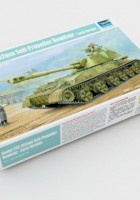
Obús autopropulsor soviético 2S3 de 152 mm - Versión temprana - Trompetista 05543

Trumpeter

Ref 05543
TipoKit de modelo
Escala1/35
Tema

Soviet 2S3 152mm Self-Propeller Howitzer – Early Version

Un modelo de la marca Trumpeter el kit: Soviet 2S3 152mm Self-Propeller Howitzer – Early Version – Trumpeter 05543.

Features : The kit consists of over 530 parts -the kit w/refined detail -multi-slide moulded turret, upper hull and lower hull -240 individual tracks links

Designated M1973 by the US Army, the Akatsiya is armed with a 152.4 mm howitzer based on the Soviet 152.4 mm D-20 howitzer and is sometimes confused with the M109 self-propelled artillery. The artillery system was developed at the design bureau No. 9 of Kalinin Machine-Building Plant in Sverdlovsk. The factory designation of the howitzer is D-22 and the GRAU designation, 2A33. The chassis was developed by Uraltransmash. Driver’s and engine-transmission compartments are located in a front part of a hull, fighting compartment with rotatory turret – in middle and rear parts of the hull. The armour is welded rolled steel. Howitzer is equipped with R-123 radio set, R-124 intercom, automatic NBC system with filtration unit and fire-fighting equipment. The V-59 12-cylinder four stroke water-cooled diesel engine connects with a mechanical twin gear transmission, a gear box is in one block with a planetary steering gear. SO-152 has self-entrenching equipment which allows to prepare a trench within 20-40 min. The crew consists of 4-6 men: a driver, a gunner, a loader, a commander, and two ammunition bearers, which are positioned to the rear of the vehicle feeding rounds through two hatches in the hull rear when in masked firing position.

Source: Trumpeter

Continuar leyendo

Vistas : 2110

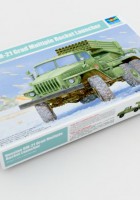
Lanzador de cohetes múltiple ruso BM-21 Grad - Trumpeter 01013

Trumpeter

Ref 01013
TipoKit de modelo
Escala1/35
Tema

Russian BM-21 Grad Multiple Rocket Launcher

Un modelo de la marca Trumpeter el kit: Russian BM-21 Grad Multiple Rocket Launcher – Trumpeter 01013.

Features : Detailed multi-directional slide-molded cab. Full drive train assembly complete with engine transmission, differential housing and suspension units. The main tires are hollow rubber with very good tread pattern Wheel hubs are in great details with separate hub rings. The windshield and side windows are made of clear prts. Photo-etched parts included

The BM-21 Grad is a Russian truck-mounted 122 mm multiple rocket launcher, developed in the early 1960s. Several other countries have copied it or developed similar systems. The BM-21 122 mm multiple rocket launcher (MRL) system entered service with the Soviet Army in 1963 to replace the aging 140 mm BM-14 system. It consists of a Ural-375D 6X6 truck chassis fitted with a bank of 40 launch tubes arranged in a rectangular shape that can be turned away from the unprotected cab.In 1976, the BM-21 was mounted on the newer Ural-4320 six-by-six army truck.

Source: Trumpeter

Continuar leyendo

Vistas : 1460

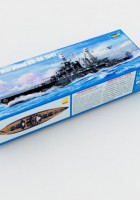
USS Maryland BB-46 1941 - Trompetista 05769

Trumpeter

Ref 05769
TipoKit de modelo
Escala1/700
Tema

USS Maryland BB-46 1941

Un modelo de la marca Trumpeter el kit: USS Maryland BB-46 1941 – Trumpeter 05769.

Features : Lower hull & upper hull made from multi-directional slide moulds. – Either full hull version or waterline version can be selected. – Deck wood pattern finely rendered – Contains two OS2U plane – Contains display stand and engraved name plate – Photo-etched frets included

USS Maryland (BB-46), as the Colorado class battleship second ship.Build in 1917 at the Newport news shipyard, launched in 1920, Service in 1921. USS Maryland mainly on training, and participated in various fleet problem-solving exercises.In 1941, the Japanese Navy attacked Pearl Harbor, USS Maryland also attacked and damaged in the harbor.After the attack on the America Maryland returned to repair, and made for modernization.1942 USS Maryland returned to fight in the war, and has taken part in the Gilbert and Marshall Islands, the Mariana Islands and Palau in the war and the battle of Leyte gulf.After the battle of USS Maryland, was a kamikaze aircraft suicide attack, had to withdraw repair.After the battle of Okinawa and Maryland, and to assist the Allied forces after Japan’s surrender in the occupation of the local, and then return.USS Maryland retired 1947, and in 1959 except by selling dismantling.

Source: Trumpeter

Continuar leyendo

Vistas : 932

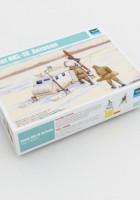
NKL-16 Aerosan soviético - Trompetista 02337

Trumpeter

Ref 02337
TipoKit de modelo
Escala1/35
Tema

Soviet NKL-16 Aerosan

Un modelo de la marca Trumpeter el kit: Soviet NKL-16 Aerosan – Trumpeter 02337.

Features : The kit consists of over 210 parts ,includes one piece of Photo Etched parts – Details finely represented by newly tooled parts

The NKL-16 was an aerosan introduced by the Soviet Union during the World War II, based on the earlier NKL-6 . It was made of plywood, powered by an M-11G aircraft engine. During WWII, improved NKL-16/41 and NKL-16/42 models were built, and production started at the ZiS and GAZ car factories, and at smaller industries such as the Stalingrad Bekietovskiy Wood Works. The NKL-16s were organized into transport battalions with NKL-26s.

Source: Trumpeter

Continuar leyendo

Vistas : 1425

Me 323 Gigant - Fotos del álbum

Yo 323 Gigant

PeríodoSegunda Guerra Mundial
Ref

Yo 323 Gigant

DescripciónÁlbum de 100 fotos de Me 323 Gigant

The Messerschmitt Me 323 Gigant (“Giant”) was a German military transport aircraft of World War II. It was a powered variant of the Me 321 military glider and was the largest land-based transport aircraft of the war. A total of 213 are recorded as having been made, a few being converted from the Me 321. The Me 323 was the result of a 1940 German requirement for a large assault glider in preparation for Operation Sea Lion, the projected invasion of Great Britain. The DFS 230 light glider had already proven its worth in the Battle of Fort Eben-Emael in Belgium (the first ever assault by gliderborne troops), and would later be used successfully in the invasion of Crete in 1941. However, in order to mount an invasion across the English Channel, the Germans would need to be able to airlift vehicles and other heavy equipment as part of an initial assault wave. Although Operation Sea Lion was cancelled, the requirement for a heavy air transport capability still existed, with the focus now on the forthcoming Operation Barbarossa, the invasion of the Soviet Union. On 18 October 1940, Junkers and Messerschmitt were given just 14 days to submit a proposal for a large transport glider. The emphasis was still very much on the assault role: the ambitious requirement was to be able to carry either an 88 mm gun and its half-track tractor, or a Panzer IV medium tank. The Junkers Ju 322 Mammut reached prototype form but was eventually scrapped due to difficulties in procuring the necessary high-grade timber for its all-wood construction and, as was discovered during the Mammut’s only test flight, an unacceptably high degree of instability inherent in the design. The proposed Messerschmitt aircraft was originally designated Me 261w, then changed to Me 263 and eventually became the Me 321. Although the Me 321 saw considerable service in Russia as a transport, it was never used for its intended role as an assault glider.

Fuente: Wikipedia

Continuar leyendo

Views : 7607

IS-4

IS-4

PaísUnión Soviética
Tipo

Tanque pesado

Descripción

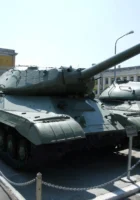
Álbum de 58 fotos walk-around de un «IS-4»

Gallery Photo of a IS-4, The development of the vehicle was started in April 1944, with several prototypes manufactured by the end of World War II. The IS-4 was mass-produced from 1947 through 1949, with a total of 219 vehicles built. The IS-4 is a very versatile tank, with fair speed, a good gun, and thick sloped armor. When armed with the 122mm M62-T2 gun, it becomes a fearsome opponent, capable of belting out generous amounts of damage. It trades frontal armor from its predecessor, the ST-I, in exchange for better side armor and higher mobility. While it still is not as nimble as its counterpart, the IS-7, it sports better penetration and rate of fire. While its frontal armor is thinner than other tier X tanks, it compensates by having a great slope on the frontal armor plating, meaning that you will bounce enemy shots effectively. The IS-4 marks the end of one of the Soviet heavy tank lines.

Fuente: Mundo del tanque

Continuar leyendo

Vistas : 3894

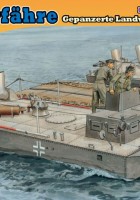
Panzerfahre Gepanzerter Landwasserschlepper Prototipo Nr.II - DML 7490

Dragon Model

Ref 7490
Tipo1/72 Militar de la Segunda Guerra Mundial
Escala1/72
Tema

Panzerfahre Gepanzerter Landwasserschlepper Prototipo Nr.II

Un modelo de la marca Modelo dragón el kit : Panzerfahre Gepanzerter Landwasserschlepper Prototipo Nr.II – DML 7490

Panzerfahre Gepanzerte Landwasserschlepper is authentically produced Chain links of front and rear hull Rivets on upper hull are detailed and realistic Spotlights exhibit extreme detail Commander’s compartment intricately produced Air intake accurately presented Detailed assembly w/3D-designed engine exhaust mufflers Well-detailed cable drum Crane is intricately presented Idler wheels w/correctly detailed parts Sprocket wheels w/breathtaking detail and multiple delicate parts Road wheels and suspension w/accurate details One-piece DS tracks reproduced

Fuente: Dragón

Continuar leyendo

Vistas : 1265

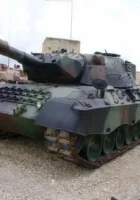
Leopardo 1A1

Leopardo 1

País Alemania Occidental
Papel Tanque de batalla principal
En servicio 1965-presente
Después de que se entregó el primer lote, los siguientes tres lotes fueron Leopardo 1A1 model, which included a new gun stabilization system from Cadillac-Gage, allowing the tank to fire effectively on the move. The 1A1 also added the now-famous “skirts” along the sides to protect the upper tracks, and a new thermal jacket on the gun barrel to control heating. A less important change was to use rectangular rubber blocks fastened to the treads with a single pin instead of the earlier two-pin “shaped” versions. The rubber blocks could be easily replaced with metal X-shaped crampons for movement on ice and snow in the winter. Between 1974 and 1977 all of the machines in the first four batches were brought to the same Leopard 1A1A1 standard, and given additional turret armor developed by Blohm & Voss. A further upgrade in the 1980s added leftover image-intensifier night sights which were being handed down from the Leopard 2 as they were themselves upgraded. The PZB 200 image intensification system was mounted in a large box on the upper right of the gun, creating the Leopard 1A1A2. A further upgrade with SEM80/90 all-digital radios created the Leopard 1A1A3.
Fuente: Leopardo 1 en Wikipedia
Continuar leyendo

Views : 13760

Japonés Tipo 1 - Tamiya 35095

Tamiya

Ref 35095
TipoModelo de escala
Escala1/35
Tema

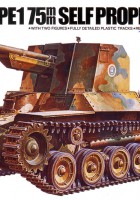
Japanese Type 1

Un modelo de la marca Tamiya el kit: Japanese Type 1 – Tamiya 35095 .

-Riveted hull details -75mm gun is movable. Gun barrel also enables recoil movement. -Belt type tracks included. -Kit comes with 2 crew figures. The Japanese Type 1 75mm self-propelled gun was the first self-propelled gun developed by the Imperial Japanese Army during WWII. It used the chassis of the successful Type 97 medium tank with the turret replaced by a Type 90 75mm field gun in an open superstructure. Although the prototype was completed in May 1941, production did not begin until the latter half of 1943 as priority was given to aircraft manufacturing during the war. The self-propelled guns were deployed to Mobile Artillery Regiments and first saw action during the Battle of Luzon in the Philippines in 1944. The Tamiya model faithfully captures all the detail in 1/35 scale.

Fuente: Tamiya

Continuar leyendo

Vistas : 1995