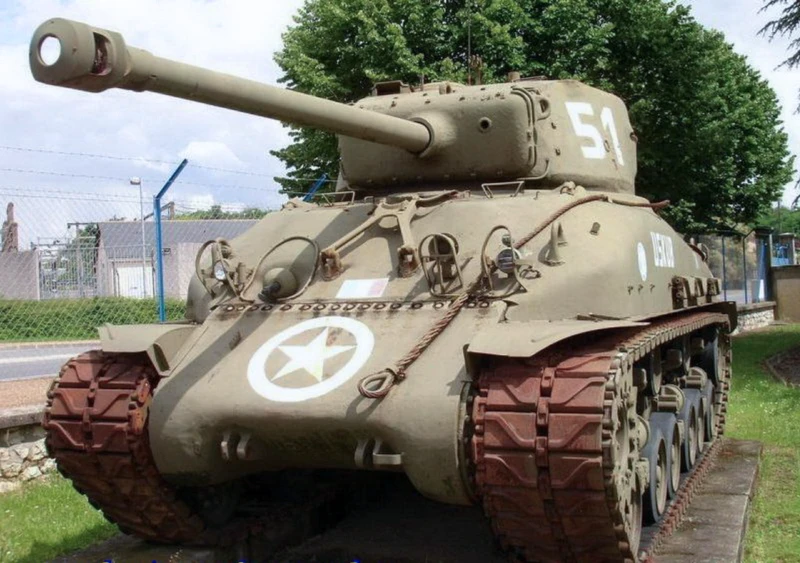
Љerman | |
|---|---|
| Zemlja | Sad |
| Ulogu | Srednji rezervoar |
| U službi | 1942–1957 |
| Izgradio | 49000+ |
Čaj M4 Šerman, zvanično Srednji tenk, M4, bio je najšire korišćeni srednji tenk sjedinjenih Država i zapadnih saveznika u Drugom svetskom ratu. M4 Šerman se pokazao kao pouzdan, relativno jeftin za proizvodnju, i dostupan u velikom broju. Hiljade ljudi je podeljeno kroz program "Lend-Lease" britanskom Komonveltu i Sovjetskom Savezu. Tenk su nazvali Britanci za američkog generala građanskog rata Vilijama Tekumseha Šermana.
Izvor: World of Tank
| Sherman Tank | |
|---|---|
| Fotograf | Nepoznato |
| Lokalizacija | Nepoznato |
| Fotografije | 28 |

| M4A3E8 Sherman Walk Around | |
|---|---|
| Fotograf | Bill Maloney |
| Lokalizacija | Paton muzej |
| Fotografije | 17 |
Pogledajte i:


| M4A3E2 Sherman Walk Around | |
|---|---|
| Fotograf | Den Rid |
| Lokalizacija | Nepoznato |
| Fotografije | 47 |
The Industrial Titan of Allied Armored Warfare
Čaj M4 Šerman, officially designated as the Medium Tank, M4, was the undisputed industrial backbone of Western Allied armored forces during World War II. Named after American Civil War General William Tecumseh Sherman, the vehicle was designed around a philosophy of reliability, ease of mass production, and global strategic mobility. While individual German tanks like the Panther or Tiger often possessed heavier armor and guns in a direct duel, the Sherman was designed to be transported in vast quantities across oceans, repaired in the field with standardized parts, and driven thousands of miles with minimal mechanical breakdown. Produced in dozens of specialized variants and built by eleven different American manufacturing plants, the Sherman proved to be a versatile, highly adaptable platform that carried United States, British, Soviet, and Free French forces to ultimate victory across Europe, North Africa, and the Pacific.
| Attribute | Technical Specification (M4A3(75)W Sherman Standard) |
|---|---|
| Ulogu | Srednji rezervoar |
| Posada | 5 (Commander, Gunner, Loader, Driver, Assistant Driver/Bow Gunner) |
| Powerplant | 1 × Ford GAA 18-liter V8 liquid-cooled gasoline engine (500 hp) |
| Maksimalna brzina | 40 to 48 km/h (25 to 30 mph) on roads | ~20 km/h (12 mph) cross-country |
| Combat Weight | 30.3 metric tons (33.4 short tons) |
| Operativni opseg | ~160 to 240 km (100 to 150 miles) depending on engine model |
| Primary Armament | 1 × 75 mm M3 L/40 gun (or 76 mm M1A2 velocity gun in later models; 90 to 97 rounds carried) |
| Sekundarno naoružanje | 1 × .50 caliber (12.7mm) Browning M2HB anti-aircraft machine gun | 2 × .30 caliber (7.62mm) Browning M1919A4 machine guns (coaxial and bow) |
| Armor Thickness | Upper Front Glacis: 51mm to 63mm angled at 47° to 56° (~90mm effective) | Turret Front: 76mm to 89mm |
| Production Total | 49,234 units (all variants) produced between February 1942 and June 1945 |
Design Engineering: Standardization, Radial Engines, and “Wet” Ammunition Storage
- Built for Ocean Shipping and Crane Limits: One of the primary constraints during the Sherman’s design was logistical transportability. The tank’s width, weight (around 30 tons), and overall height were carefully tailored to fit on standard American cargo ships, railway cars, and harbor cranes. This allowed thousands of tanks to be shipped from American factories to ports in Britain, North Africa, and the Soviet Union without requiring specialized, heavy transport equipment.
- Multi-Engine Adaptability: Because wartime demand for engines was so immense, the Sherman chassis was engineered to accommodate four entirely different engine types across various factories. Models utilized aircraft-style Wright Continental radial engines (M4), Detroit Diesel dual engines (M4A2), Ford V8 gasoline engines (M4A3), and even a complex 30-cylinder Chrysler “Multibank” engine created by linking five car engines together (M4A4).
- Solving the “Ronsons” Fire Myth (“Wet Storage”): Early Shermans earned a reputation for catching fire easily when penetrated, leading soldiers to call them “Ronsons” (after a lighter brand advertised to “light first time, every time”). However, Army investigators discovered the fires were caused by propellant fires from dry ammunition racks in the sponsons, not the gasoline engines. Later models introduced “Wet” Stowage (indicated by a “W” in the model name), surrounding shell racks with water and glycol jackets. This single design tweak reduced post-penetration ammunition fires by over 80%.
- The 76mm and Firefly Upgrades: As heavier German tanks appeared, the original dual-purpose 75mm gun (which had excellent high-explosive capability for infantry support) struggled to penetrate heavy front armor. The US army introduced the high-velocity 76mm M1 gun in an enlarged turret (T23), while British forces created the legendary Sherman Firefly by squeezing their massive 17-pounder anti-tank gun into the Sherman’s turret, giving the tank the punch needed to take out Tigers and Panthers at long distances.
Operational History: From North African Deserts to the Post-War Era
- Turning the Tide at El Alamein (1942): The Sherman made its combat debut with the British Eighth Army at the Second Battle of El Alamein in late 1942. At the time of its arrival, the Sherman was superior to almost every German and Italian tank on the battlefield, possessing thicker armor, better mobility, and a 75mm gun capable of firing both effective high-explosive shells against artillery and anti-tank rounds.
- Combined Arms Tactics in Western Europe (1944–1945): During the breakout from Normandy and the drive into Germany, US armored doctrine relied on the Sherman to work closely with infantry and air support. Equipped with radios in every tank—a luxury many opponent tanks lacked—Sherman crews could coordinate instantly with artillery batteries and P-47 Thunderbolt fighter-bombers. Their fast turret traverse speeds (driven by a smooth hydraulic motor) allowed crews to react to surprises far faster than heavily armored German vehicles could rotate their turrets.
- Pacific Jungle Warfare: In the Pacific Theater, the M4 Sherman dominated Japanese armored forces, which consisted mostly of lightly protected tanks like the Type 97 Chi-Ha. Shermans acted as heavily armored mobile pillboxes, blasting Japanese bunker complexes with high explosives and flame-thrower variants (such as the “POA-CWS-H1” attachments) during bloody island-hopping campaigns on Iwo Jima, Okinawa, and the Philippines.
- Post-WWII Global Legacy: The Sherman’s service extended far beyond World War II. Re-engineered versions served extensively in the Korean War (M4A3E8 “Easy Eight” models) matching Soviet T-34-85s. Israel later modified the platform into the “Super Sherman” and “Isherman” (M-50 and M-51), fitting massive French 105mm guns that successfully engaged modern Arab armor during the 1967 Six-Day War and 1973 Yom Kippur War, cementing the chassis as one of the longest-serving tank designs in history.
Views : 10471
Možete videti i :
 M4A2 – Walk Around
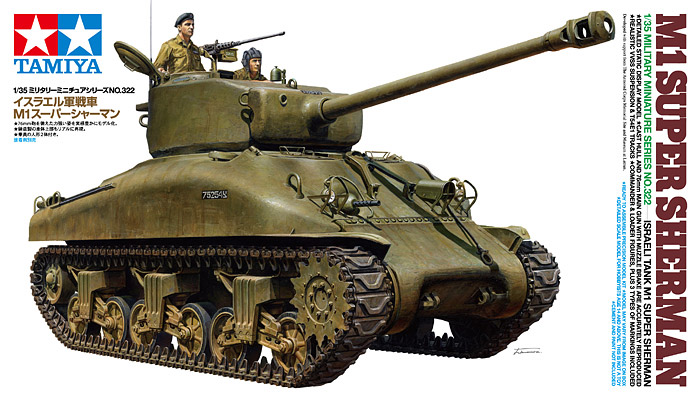 Tenk M1 Super Šerman – Tamija 35322
 M4A1 – Sherman Grizzly – Walk Around
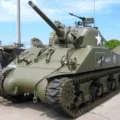 M4 Sherman – Walk Around
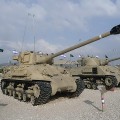 Super Šerman M-51 – Walk Around
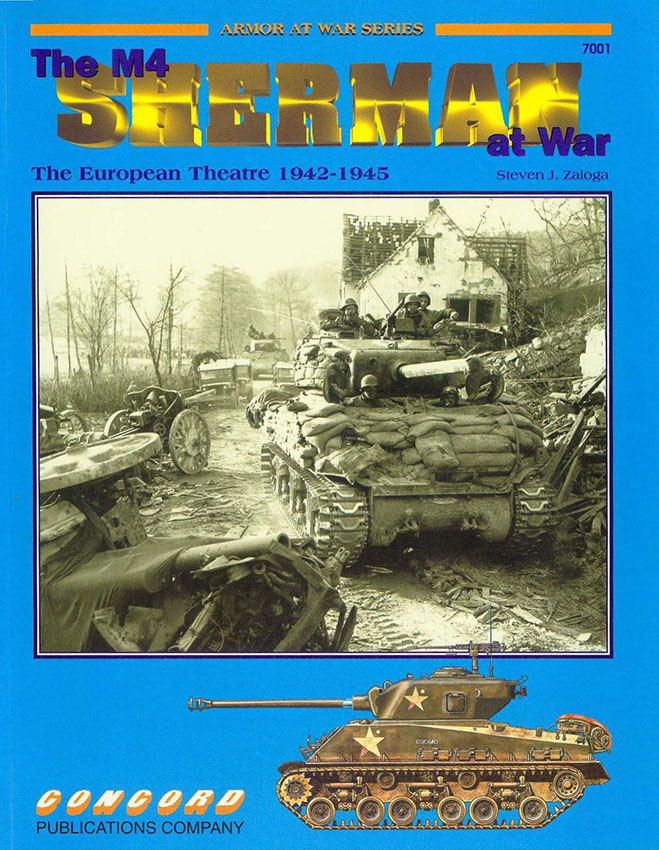 The M4 Sherman At War – Armor At War 7001
 Šerman – Waffen Arsenal 045
 Šerman u akciji – Eskadrila Signal SS2016
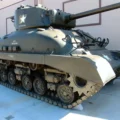 M4A1 – Šerman – Šetnja okolo
 M4 (76mm) Sherman Medium Tank 1943–65 – NEW VANGUARD 73