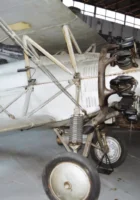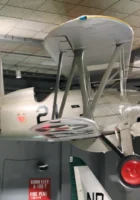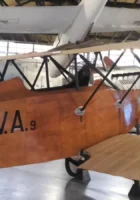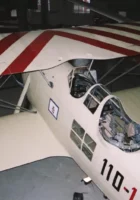
IMAM Ro 37bis |

IMAM Ro 37bis |

PaísItália
PapelBiplano de reconhecimento
Primeiro voo6 de novembro de 1933
Construído617

Galeria de fotos de um IMAM Ro 37bis |, The Meridionali Ro.37 Lince (Italian: “Lynx”) was a two-seater Italian reconnaissance biplane, a product of the Industrie Meccaniche Aeronautiche Meridionali (IMAM) company. It appeared in 1934 and had a composite structure of wood and metal. The aeroplane first saw operational duty in the Second Italo-Ethiopian War (1935-1936) and Spanish Civil War (1936-1939), and during the Second World War it saw duty on almost all fronts, except for Russia and the English Channel. It followed the Ro.1 as the main reconnaissance aircraft for the Italian Army.

Fonte: IMAM Ro 37bis na Wiki

Continue lendo

Views : 4393

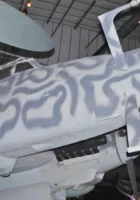
Messerschmitt Bf 110

Messerschmitt Bf 110

PaísAlemanha nazista
PapelCaça pesado – Aeronave de ataque terrestre - Caça-bombardeiro/Caça Noturno
Primeiro voo12 de maio de 1936
Construído6170

Galeria de fotos de um Messerschmitt Bf 110, The Messerschmitt Bf 110, often (erroneously) called Me 110, was a twin-engine heavy fighter (Zerstörer—German for “Destroyer”) and fighter-bomber (Jagdbomber or Jabo) developed in Nazi Germany in the 1930s and used by the Luftwaffe and others during World War II. Hermann Göring was a proponent of the Bf 110. It was armed with two MG FF 20 mm cannons, four 7.92 mm (.312 in) MG 17 machine guns, and one 7.92 mm (.312 in) MG 15 machine gun or twin-barrel MG 81Z for defence. Development work on an improved type to replace the Bf 110, the Messerschmitt Me 210 began before the war started, but its teething troubles from its aerodynamics resulted in the Bf 110 soldiering on until the end of the war in various roles, alongside its replacements, the Me 210 and the significantly improved Me 410 Hornisse.

Fonte: Messerschmitt Bf 110 na Wiki

Continue lendo

Views : 10668

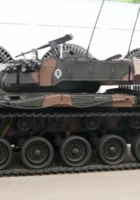
Buldogue Walker M41B

Buldogue Walker M41B

PaísEua
PapelTanque de luz
Produzido1951–1954
Construído5467

Galeria de fotos de um Buldogue Walker M41B, The M41 Walker Bulldog was an American light tank developed to replace the M24 Chaffee. It was named for General Walton Walker who died in a jeep accident in Korea. On 7 November 1950, the US Ordnance Committee Minutes (OCM) issued item #33476, redesignating the heavy, medium, and light tank, according to the main armament; the 120mm and 105mm caliber (heavy, larger-than-100mm) Gun Tanks, 90mm (medium) Gun Tanks, and the 76mm (light) Gun Tanks.

Fonte: M41B Bulldog Walker na Wiki

Continue lendo

Visualizações : 5543

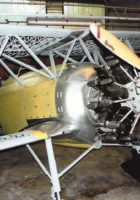
Fiat CR-42

Fiat CR.42

PaísItália
TipoCaça sesquiplane de assento único
Primeiro voo23 de maio de 1938
Construído1819

Galeria de fotos de um Fiat CR.42, The Fiat CR.42 Falco was a single-seat sesquiplane fighter that served primarily in Italy’s Regia Aeronautica before and during World War II. The aircraft was produced by Fiat Aviazione, and entered service, in smaller numbers, with the air forces of Belgium, Sweden and Hungary. With more than 1,800 built, it was the most numerous Italian aircraft in World War II. The CR.42 was the last of the Fiat biplane fighters to enter front line service, and represented the epitome of the type, along with the Gloster Gladiator.

Fonte: Fiat CR.42 no Wiki

Continue lendo

Views : 4566

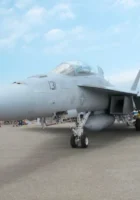
Boeing F-18F Super Hornet

F-18F Super Hornet

PaísEua
TipoAviões de combate Multirole
Produzido1995-presente
Construído500+

Galeria de fotos de um F-18F Super Hornet, The Boeing F/A-18E and F/A-18F Super Hornet are twin-engine carrier-capable multirole fighter aircraft variants based on the McDonnell Douglas F/A-18 Hornet. The F/A-18E single-seat and F/A-18F tandem-seat variants are larger and more advanced derivatives of the F/A-18C and D Hornet. The Super Hornet has an internal 20 mm M61 rotary cannon and can carry air-to-air missiles and air-to-surface weapons. Additional fuel can be carried in up to five external fuel tanks and the aircraft can be configured as an airborne tanker by adding an external air refueling system.

Fonte: F-18F Super Hornet na Wiki

Continue lendo

Views : 16860

Caproni Ca.113

Caproni Ca.113

PaísItalia
TipoAeronaves biplanares de treinamento
FotógrafoTiberio Riva
Descrição

Álbum de 133 fotos de um «Caproni Ca.113»

Galeria de fotos de um Caproni Ca.113, The Caproni Ca.113 was an advanced training biplane produced in Italy and Bulgaria in the early 1930s. Designed as a follow-on to the Ca.100, it was a more powerful and robust aircraft capable of aerobatics. It was a conventional design with two cockpits in tandem, single-bay staggered wings of equal span, and mainwheels covered by large spats.

Fonte: Caproni Ca.113 na Wiki

Continue lendo

Visualizações : 2304

Boeing P-26

Boeing P-26

PaísEua
TipoAeronaves de perseguição
Primeiro voo20 de março de 1932
Construído151

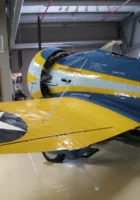
O Boeing P-26 "Peashooter" foi o primeiro avião de combate americano de produção totalmente metálico e o primeiro monoplano de perseguição a entrar em serviço de esquadrão com o Corpo Aéreo do Exército dos Estados Unidos. Projetado e construído pela Boeing, o protótipo voou pela primeira vez em 1932, e o tipo ainda estava em uso com o Corpo Aéreo do Exército dos EUA até 1941 nas Filipinas. Existem apenas dois Peashooters sobreviventes, mas há três reproduções em exibição com mais duas em construção.

Fonte: Boeing P-26 na Wiki

Continue lendo

Views : 5290

Bleriot XI

Bleriot XI

PaísFrança
PapelAeronave
Primeiro voo23 de janeiro de 1909
ConstruídoReino Unido

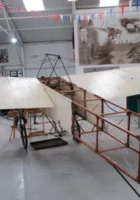
Galeria de fotos de um Bleriot XI, The Blériot XI is a French aircraft. The first example was used by Louis Blériot to make the first flight across the English Channel in a heavier-than-air aircraft on 25 July 1909. This achievement is one of the most famous accomplishments of the pioneer era of aviation, and not only won Blériot a lasting place in history but also assured the future of his aircraft manufacturing business. The event caused a major reappraisal of the importance of aviation; the English newspaper The Daily Express led its story of the flight with the headline “Britain is no longer an Island”.

Fonte: Bleriot XI na Wiki

Continue lendo

Visualizações : 3647

Ansaldo SVA

Ansaldo SVA

PaísItália
TipoAeronaves biplanas de reconhecimento
FotógrafoTiberio Riva
Descrição

Álbum de 140 fotos walk-around de um «Ansaldo SVA»

Galeria de fotos de um Ansaldo SVA, The Ansaldo SVA (named for Savoia-Verduzio-Ansaldo) was a family of Italian reconnaissance biplane aircraft of World War I and the decade after. Originally conceived as a fighter, the SVA was found inadequate for that role. Nevertheless, its impressive speed, range and operational ceiling, with its top speed making it one of the fastest (if not the fastest) of all Allied combat aircraft in World War I, gave it the right properties to be an excellent reconnaissance aircraft and even light bomber. Production of the aircraft continued well after the war, with the final examples delivered in 1918. Two minor variants were produced, one with reconnaissance cameras, the other without cameras but extra fuel tanks.

Fonte: Ansaldo SVA na Wiki

Continue lendo

Visualizações : 4305