Squadron Signal 5722 Valentine Tank

Squadron Signal

SerieAmor Walk Around
RefSS5722
TopicValentine Tank
Periodwwii

A book signed Squadron Signal the revue «Valentine Tank Walk Around – Squadron Signal SS5722» .

The Valentine Infantry Tank III, a private venture design from Vickers-Armstrong, was the 3rd of Great Britain’s infantry tank designs. Though not the 1st tank to go into battle against the Axis in WWII, the Valentine has the distinction of having the highest production numbers of any wartime British tank, and arguably the most variations. A total of 8,275 Valentines were produced in no fewer than 11 major variants. Early versions of the vehicle were equipped with gasoline engines, while a diesel powered the later Marks. The turret also saw development, with later models fit with a more elongated design. The Valentine received its baptism of fire with the British 8th Army in Operation Crusader in North Africa during July 1941, just the beginning of a long career, as they would eventually take part in combat in both the European and Pacific Theaters. After the war, Valentines continued to serve several British Commonwealth armies as late as the 1950s. Besides fighting under the Union Jack, Valentines saw action with the armed forces of Canada, the Soviet Union, Australia, and New Zealand. Illustrated with 250 photos, plus color profiles and detailed line drawings. Doyle; 88 pages.

Source: Squadron Signal

Continue reading

Views : 979

Squadron Signal 5721 M108-M109 Howitzer

Squadron Signal

SerieAmor Walk Around
RefSS5721
SubjectM108/M109 Howitzer
Periodwwii

A book from Squadron Signal the book «M108/M109 Howitzer Walk Around – Squadron Signal SS5721» .

History: Introduced in the early 1960s, the M108/M109 marked the transition from open-topped to fully enclosed self-propelled artillery. Developed simultaneously, the M108 and M109 went from experimental to ‘standard’ classification in July 1963. Production of the M108 was concluded within months, as its 105mm gun was found to be less well-suited than the M109’s 155mm cannon. Both vehicles saw service in Vietnam. In 1972, the M109s were rearmed with longer barrels resulting in the M109A1. Various modifications were introduced in subsequent years, and in the mid-1980s the M109 family was upgraded to include nuclear, chemical, and biological protection – those modified units being redesignated M109A4. Then in February 1990, a version incorporating enlarged turret, improved armor and armament, increased ammunition stowage, NBC protection and microclimate for the crew became available under the designation M109A6, the ‘Paladin,’ a thoroughly modern weapon able to go from road march to pinpoint firing in less than 60 seconds.

Illustrated with more than 315 photographs, plus color profiles and detailed line drawings. Doyle; 88 pages.

Source: Squadron Signal

Continue reading

Views : 1032

Squadron Signal 5720 M3A1 Scout Car

Squadron Signal

SerieAmor Walk Around
PeriodWWII
RefSS5720
TopicM3A1 White Scout Car

A book signed Squadron Signal the book «M3A1 White Scout Car Walk Around – Squadron Signal SS5720» .

The White Motor Company began serial production of the four-wheel-drive M3A1 Scout Car in 1940. Covered in quarter-inch face-hardened armor, the vehicle served the US military as scout, command car, ambulance and in some cases as a gun tractor. Armed with one .50 caliber and two .30 caliber machine guns on a skate rail that completely surrounded the f ighting compartment, the M3A1 saw action in the Philippine tropics, the North African desert and during the 1943 invasion of Sicily. However, US forces soon replaced the open-topped M3A1 with other armored vehicles that afforded better coverage. Because the vehicle was widely exported it served on – heavily used by the Red Army on the Eastern Front and by Free French, Belgian, Czechoslovak and Polish forces throughout WWII. Later, France took the vehicle into combat in colonial wars in Indochina and Algeria. Illustrated with more than 200 photographs, plus color profiles and detailed line drawungs. Doyle; 80 pages.

Source: Squadron Signal

Continue reading

Views : 1095

Squadron Signal 5719 M5 Stuart Tank

Squadron Signal

SerieAmor Walk Around
RefSS5719
SubjectM5/M5A1 Stuart
Periodwwii

A book from Squadron Signal the book «M5/M5A1 Stuart Walk Around – Squadron Signal SS5719» .

The light M5 Stuart Tank was a much-upgraded version of the M3 Stuart. Named for Confederate General J.E.B. Stuart, the Stuarts filled the need for a light tank and, in addition to the US, they were supplied to Allied military forces. The leap from the M3 to the M5 Stuart took place in 1941, when the US Ordnance Department accepted a proposal by Cadillac to install double Cadillac V8 engines in the tank and, after remodeling the hull to accommodate the new motors, a new tank, the M5, was born. Reconnaissance units in the front lines of US forces were always accompanied by the agile M5s. With a top speed of 45 miles per hour, armor protection, and firepower, the M5A1 provided powerful support. Though not a match for heavy German armor, the Stuart was more than adequate for dealing with infantry. In addition to the US military, M5s were supplied to Britain, the Soviet Union and France. After WWII, the Stuart saw action in such far-flung places as China, India, and Indochina. Illustrated with more than 190 photographs, plus color profiles and detailed line drawings. Mesko; 80 pages.

Source: Squadron Signal

Continue reading

Views : 1076

GMC CCKW Truck Walk Around - Squadron Signal SS5718

Squadron Signal

SerieAmor Walk Around
RefSS5718
TopicGMC CCKW Truck
Periodwwii
A documentation signed Squadron Signal the book «GMC CCKW Truck Walk Around – Squadron Signal SS5718» . As war spread in Asia and war clouds gathered over Europe in the late 1930s, the US Army Quartermaster Corps set out to acquire a tough, new 2-1/2 ton tactical truck that would be up to the task of hauling modern artillery as well as troops and supplies. In the end General Motors filled that need with its all-wheel drive CCKW truck. The first examples rolled off GMC’s Pontiac, Michigan, assembly line in February 1941. By September 1942, the Chevrolet plant in St. Louis, Missouri, also started manufacturing the CCKW. This volume is packed with detailed photographs and highlights modifications through the years of its service – a wooden truck bed to save on precious steel, an open cab to allow for more cargo room in ship holds, 2 designs for axles, negative electrical system and a winch that was installed on a third of the trucks. Covers long- and short-wheelbase versions, plus cargo dump body types. Don’t miss this close-up look at the truck that carried US men and materiel to victory on 3 continents in WWII! Illustrated with more than 190 photographs, plus color profiles and detailed line drawings; Doyle; 80 pages.

Source: Squadron Signal

Continue reading

Views : 1144

Squadron Signal 5717 M7 Priest

Squadron Signal

SeriesAmor Walk Around
RefSS5717
TopicM7 Priest
Periodwwii

Signed documentation Squadron Signal le livre «M7 Priest Walk Around – Squadron Signal SS5717» .

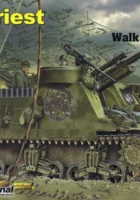
The US M7 self-propelled 105mm Howitzer, known as the Priest, was originally developed on the basis of an M3 medium tank chassis. Nicknamed the Priest be cause of its pulpit-like anti-aircraft ring, the vehicle was intended to provide armored units with organic, highly-mobiile artillery support. Production began in April 1942 and it first went into combat with British at the Second Battle of El-Alamein in the autumn of that year, with US forces first taking the American – built vehicle into engagements in Tunisia somewhat later. M4 Sherman tank parts were incorporated into later Priests, in place of the earlier M3 tank components, and later models – those built during 1944 and after – also featured fold-down armor along the sides and rear of the lighting compartment. Packed with more than 230 photographs, plus color profiles and detailed line drawings. Doyle; 80 pages.

Source: Squadron Signal

Continue reading

Views : 1127

Squadron Signal 5716 M88 Armored Recovery Vehicle

Squadron Signal

SerieAmor Walk Around
TopicM88 ARV
RefSS5716
PeriodPost war

A book signed Squadron Signal the magazine «M88 ARV Walk Around – Squadron Signal SS5716» .

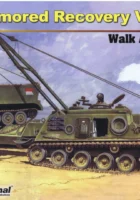
The M88 Armored Recovery Vehicle was designed and developed in the late 1950s to handle recovery of the heavier and more massive tanks that were appearing at the time. Armored like a tank and incorporating the suspension and drive train of the M48/M60 tanks, the M88 ARV is equipped with a massive winch and a hydraulically raised A-frame boom with 400 feet of 5/8″ wire rope. The M88’s original gasoline motor served the vehicle well during its years of duty in Vietnam. In the 1970s, though, a new diesel power plant was installed in the M88, which was then reclassified as an M88A1. Production for domestic use ended in 1989, but the vehicles continued to be manufactured for export. Meanwhile, a new recovery vehicle became necessary with the introduction of the massive M1 Abrams tank. The M88 had been so successful that it was taken as the basis for the new upgraded recovery vehicle, which is still in use today – the M88A2. Illustrated with 175 photographs, plus color profiles and detailed line drawings. Doyle; 80 pages.

Source: Squadron Signal

Continue reading

Views : 1208

Squadron Signal 5715 M113 Armored Personnel Carrier

Squadron Signal

SerieAmor Walk Around
TitleM113 APC Walk Around
RefSS5715
Topic

M113 APC

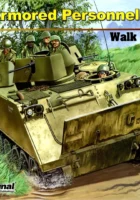
The M113 family of vehicles is arguably the most successful series of armored personnel carriers of all time. Produced in huge numbers, these ‘tracks’, served the US and its Allies from the early 1960s into the 21st century. The M113 has operated across the globe, serving alongside GIs wherever they deployed. Physical layout was logical – a hydraulically operated rear ramp allowed for quick egress from the troop compartment; the driver’s position and powerplant filled the forward spaces. The driver was provided with four M17 periscopes, and his hatch had provision for an M19 infrared periscope as well. The commander’s station, just aft of the driver, had a cupola equipped with five M17 periscopes and an M2 HB machine gun. Illustrated with 170 photographs, plus color profiles and detailed line drawings. Doyle; 72 pages.

Source: Squadron Signal

Continue reading

Views : 1340

Squadron Signal 5714 M24 Chaffee

Squadron Signal

SerieAmor Walk Around
RefSS5714
SubjectM24 Chaffee
Periodww2

A documentation signed Squadron Signal the book «M24 Chaffee Walk Around – Squadron Signal SS5714» .

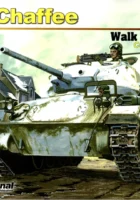
As American-built armor came into contact with Axis forces in WWII – first of all in North Africa – it quickly became clear that the 37mm cannon favored on US armor was simply inadequate against the tough armor of their adversaries. The tall silhouette and slab-sided construction of many US vehicles also demonstrated the need for a new American tank. The M24 was developed in order to address all of these concerns and more. Armed with a 75mm main gun, the Chaffee was able to dispatch many of the foes its predecessors had unsuccessfully faced, and the M24’s torsion bar suspension gave it a lower profile and smoother ride while making it an improved gun platform. Produced for the US military until 1950, the Chaffee continued to take the field around the world until well into the 1970s. Packed with over 200 photos, plus color art and profiles. Doyle; 80 pages.

Source: Squadron Signal

Continue reading

Views : 1058

Squadron Signal 5713 Panzer 38(t)

Squadron Signal

SerieAmor Walk Around
RefSS5713
SubjectPanzer 38(t)
Periodww2

A book signed Squadron Signal the revue «Panzer 38(t) Walk Around- Squadron Signal SS5713» .

The Panzerkampfwagen 38 (tschechisch) – Armored Combat Vehicle 38 (Czech) was one of the most important tanks in the Wehrmacht arsenal in the first half of WWII. Originally produced near Prague as a light tank LT vz. 38 – Lehký Tank vzor 38, the vehicle along with its manufacturing plant were appropriated by the Germans after their occupation of Czechoslovakia in 1939. Rechristened as the German name Pz.Kpfw.38(t), the vehicle saw action in the Polish and French campaigns and took part in the invasion of the Soviet Union during the summer of 1941. The relentless flow of redoubtable Soviet T-34 tanks soon made the Panzer 38(t) obsolete, however, forcing its withdrawal from front-line duties on the Ostfront in early 1942. The vehicle continued to serve in anti-partisan operations, and there were still 229 Panzer 38(t)s in active service with the German Army in September 1944. A few even confronted the Western Allies during their advance into the Third Reich late in the war. Illustrated with over 300 photographs, color art, and profiles. Stapfer; 80 pages.

Source: Squadron Signal

Continue reading

Views : 858