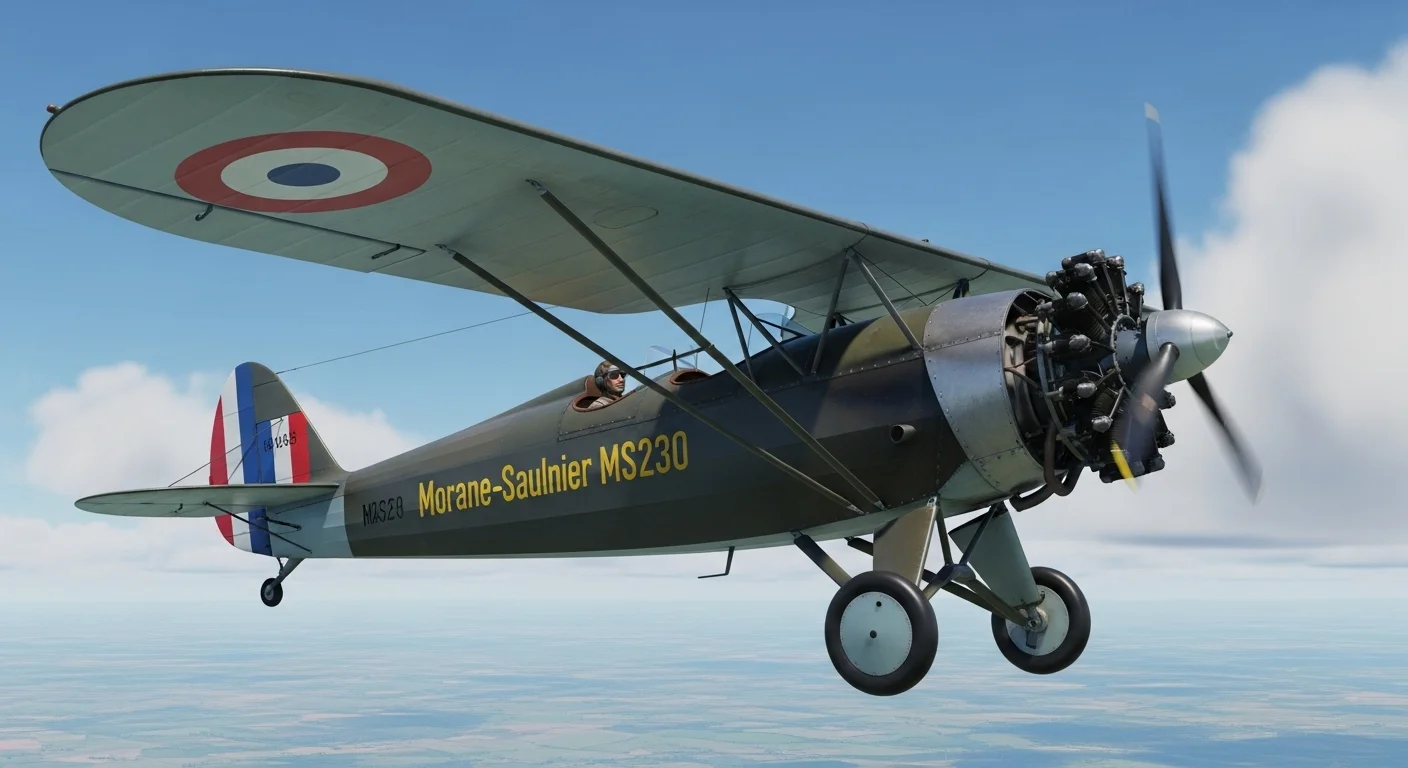
Morane-Saulnier MS.230 | |
|---|---|
| País | França |
| Tipo | Formador elementar |
| Primeiro voo | Fevereiro de 1929 |
| Construído | 1000+ |
O Morane-Saulnier MS.230 A aeronave foi o principal treinador elementar do Armée de l'Air francês ao longo da década de 1930. Quase todos os pilotos franceses que voavam para o Armée de l'Air no início da Segunda Guerra Mundial tiveram seu primeiro treinamento de vôo nesta máquina. Era o equivalente ao treinador Stearman nos serviços aéreos dos Estados Unidos e ao de Havilland Tiger Moth na Força Aérea Real Britânica.
| Morane Saulnier MS-230 Walk Around | |
|---|---|
| Fotógrafo | Pavel Senk |
| Localização | Desconhecido |
| Fotos | 26 |


Veja também:


O Morane-Saulnier MS.230 was a French monoplane designed for elementary training and advanced instruction. It was built by Morane-Saulnier, a company founded by Raymond Saulnier and the Morane brothers, Léon and Robert. The MS.230 first flew in February 1929 and entered service with the French Air Force in 1930. It was also exported to several other countries, such as Belgium, Brazil, Greece, Portugal, Romania, Switzerland and Turkey.
The MS.230 had a parasol wing with an autostable profile and a metal tubular frame covered with fabric. The fuselage had a metal skin at the front and fabric at the rear. The cockpit accommodated two crew members in tandem, with dual controls for the instructor and the student. The landing gear was fixed and wide-tracked, with Dainhaut wheels equipped with brakes and shock absorbers. The powerplant was a nine-cylinder radial engine Salmson 9Ab producing 230 hp.
The MS.230 was praised for its robustness, ease of handling, stability and versatility. It could perform various roles such as target towing, glider towing, liaison and observation. It was also used as a testbed for different engines, skis or slats. It became the main trainer aircraft for the French Air Force until World War II, with more than 1,100 units produced. Some of them survived after the war and were used by civilian flying clubs or private owners.
Visualizações: 628
Você pode ver também:
 Custer CCW-5 – Fotos e Vídeos
 FFVS J 22 – Fotos e Vídeos
 SAAB 340 AEW – Fotos e Vídeos
 Piper PA-48 Enforcer – Fotos e Vídeos
 Lockheed Electra 12 – Fotos e Vídeos
 North American X-15 – Fotos e Vídeos
 Grumman F-14 Tomcat - WalkAround
 MiG-23MLD – WalkAround
 P-51D-25-NA Mustang – Ande por aí
 B-47 Stratojet – Ande por aí